
The Hever Chair
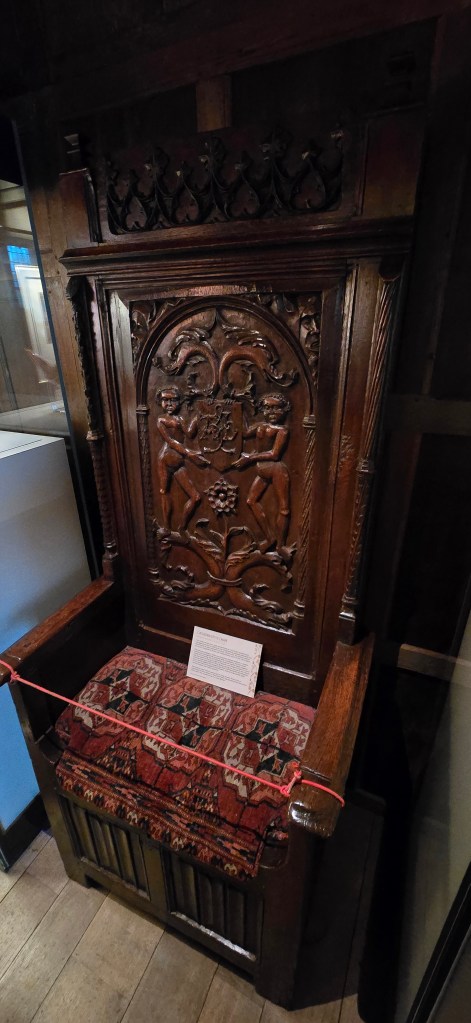
The catalogue for the exhibition at Hever Castle commemorating the 490th anniversary of Anne Boleyn’s death describes this exquisite late fifteenth/early sixteenth century wooden seat as being a cathedra-style chair that originated from the Loire region of France.
Made of walnut wood, it is made up of a series of rectangles with linenfold carving on the bottom panel supporting the seat. The arms sit on the top of further rectangular panels forming the sides and terminate with decorative carving.
The authors of the catalogue consider it may have been created for a teenage Anne Boleyn while she was at the court of Queen Claude in the early sixteenth century.[i] Their evidence rests solely on the claim that the letter on the right as we look at the chair, is a lower case ‘b’, and the flower is a rose similar to the Tudor Rose adopted by Henry VII.
Scant consideration has been given to the idea that ornate cathedra-style chairs such as this are symbols of power and authority.
When is a Chair Not a Chair?
During the past several thousand years the world has seen many wars and revolutions resulting in the fall of the emperors, kings and the many aristocratic families of various countries, yet throughout all the military turmoil a throne has remained the seat of someone of high status. The ancient thrones that have survived often carry carved iconography promoting the authority of the emperor, king or leader for whom they were made.
Many religious texts illuminated by the various “Masters of …” from the fifteenth and early sixteenth centuries contain images of God the Father, God the Son both seated on heavenly thrones with the Holy Spirit hovering above them in the form of a dove. In many books of hours there is an image of the Virgin Mary in her role as Queen of Heaven seated together with God the Father on a wide throne. In an age where the ordinary person would have had little access to luxury items such as illuminated manuscripts, personal altarpieces, or expensive items of furniture, their only experience of a hierarchical image would be when they were placed in front of an altarpiece when they attended Church.
The Ghent altarpiece (completed by van Eyck brothers in 1432), is split into two sections. The top panels depicts heaven where God is seated on a throne between the Virgin and St John the Baptist. To the right, the organist of the angelic host is seated in order to play their instrument, and is placed between the central group and a naked Eve. On the left, a naked Adam is separated from the Holy trio by the angelic choir, and together these two mortals represent God’s creation of the first humans as described in Chapter One of Genesis in the Old Testament.
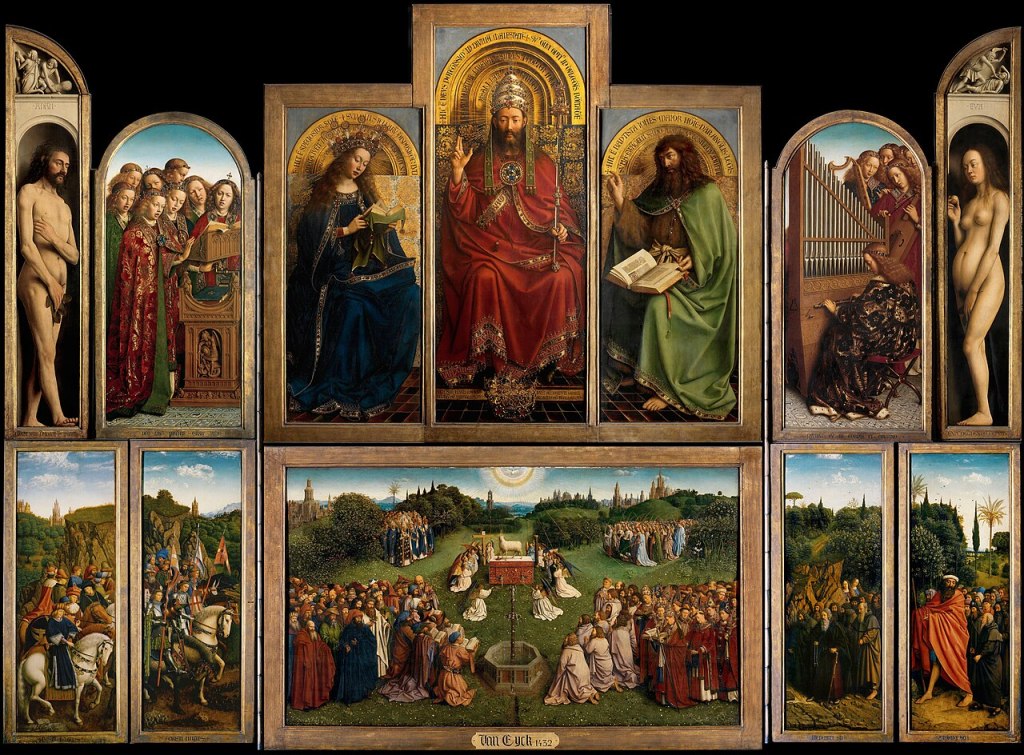
Image source: Wikipedia
The lower panel represents the earthly Christian world and the people are either standing or kneeling demonstrating that when in the presence of the Divine, none have the privilege of being seated.
For Catholics, the most important cathedra-style chair is one in St Peter’s Basilica in Rome, traditionally thought to have belonged to St Peter himself. However, it has subsequently been discovered it was made in the ninth century and gifted to the Vatican by Emperor Charles the Bald (823-877 CE), grandson of Emperor Charlemagne (748-814 CE).
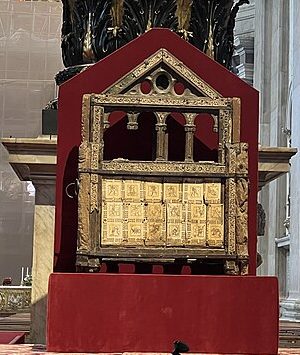
During the 17th century it was encased in a bronze throne sculpted by Gian Lorenzo Bernini (1598-1680) in order to protect it, and was
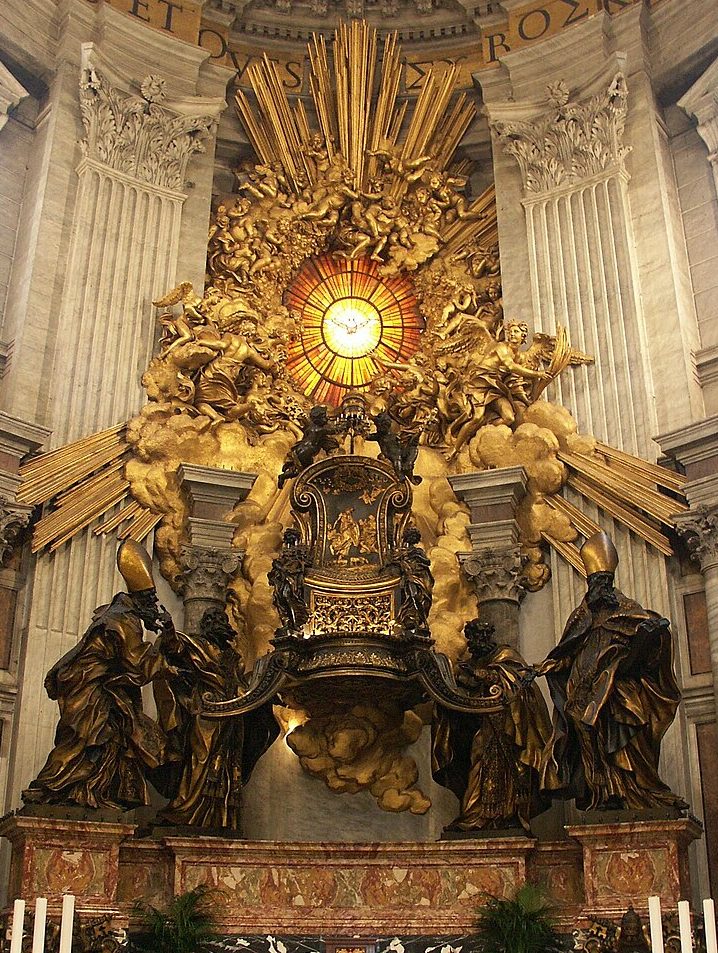
undisturbed until exposed to public view in 1867, and then again in 2024.
The English throne is only used during the coronation service when the English monarch is anointed as God’s earthly representative. The Coronation Chair, dating from 1300-1301, is kept in Westminster Abbey and was made on the orders of Edward I of oak, to contain the Stone of Scone the king had brought from Scotland in 1296.[ii]
An example dating from antiquity is the Lansdowne throne of Apollo now in the Los Angeles County Museum of Art. Carved in marble it is at lest two thousand years old and may be even older. https://collections.lacma.org/object/14919
This classical antique throne is decorated on the back panel with a serpent coiled round a bow, with the quiver (full of arrows) lying where the seat meets the back panel. The scrollwork on the top of the back panel includes four roses – emblems of the Greek goddess Aphrodite, goddess of love and money.[iii]
Seating Order of Prcedence at the French Court
The Hever catalogue poses the idea that their chair was made for Anne Boleyn when she was a member of Queen Claude of France’s ladies-in-waiting.
A chair of this high standard of production would have been taken to wherever the French court was sitting and there was a strict hierarchy of who could sit and who had to stand in the presence of the French king and queen. In his 1934 book Le Rang et l’Etiquette sous l’Ancien Regime Henry Brocher describes the etiquette at the French court for those attending the court in the reign of Louis XIV (1638-1715) who was a stickler for tradition.[iv]
When the monarchs were present the Dauphin and Dauphine could sit on a stool as could their grandchildren and Princes and Princesses of The Blood. Cardinals had to stand before the king, but could sit on a stool if the king was not present, but the queen and Sons & Daughters of France were. Cardinals were permitted a chair if talking to the Grandchildren of France and Princes and Princesses of the Blood.
When it came to duchesses, foreign princesses and female Spanish grandees they were permitted to have a small stool when appearing before the king and queen and, similar to cardinals, were permitted to sit on a chair in the presence of Grandchildren of France and Princes and Princesses of The Blood, while dukes, foreign princes and male Spanish grandees had to stand.
All ladies and gentlemen of quality had to stand. However, these ladies were permitted to sit on a stool in the presence of royal Grandchildren, but men had to remaining standing. Ladies and gentlemen could sit either on a stool or on the floor in the presence of Princes and Princesses of the Blood. Brocher does not say whether or not they were permitted the luxury of a cushion to relieve the lack of comfort when sitting on a hard, cold floor.
The possible origins of the throne now at Hever
Château Amboise became a French royal residence when it was seized by Charles VII in September 1434. Later in the fifteenth century Charles VIII employed two Italian builders to renovate the château who introduced many decorative Italian Renaissance elements. The château became a favourite of Queen Claude when she became queen after the death of her parents, Louix XII and Anne de Bretagne, twice queen of France and Duchess of Brittany suo jure.
The largest panel forms the back support and is decorated with carved columns either side of a central arch containing iconographical carving.
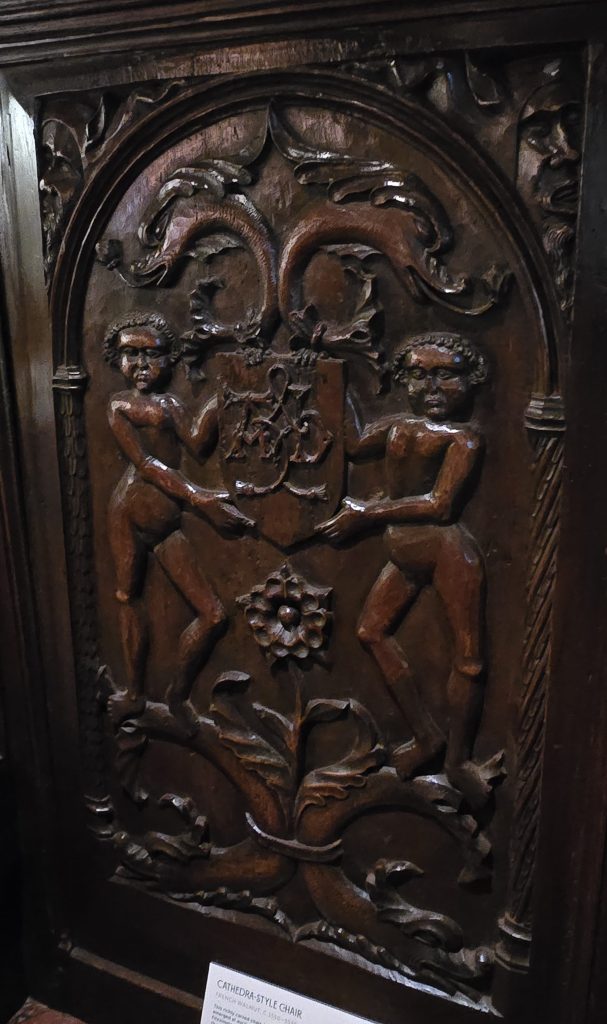
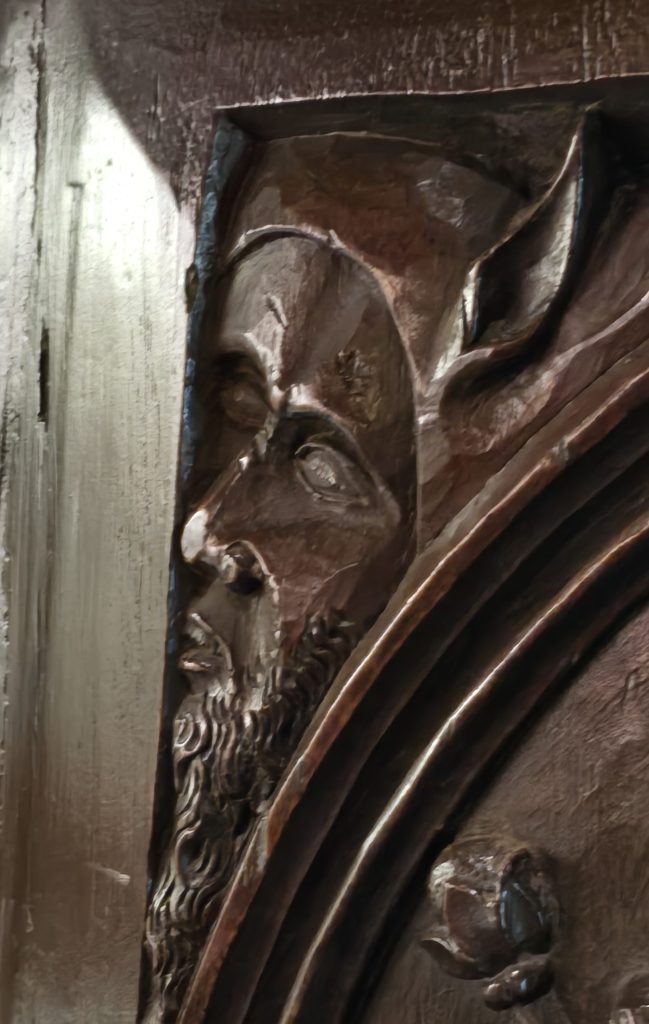
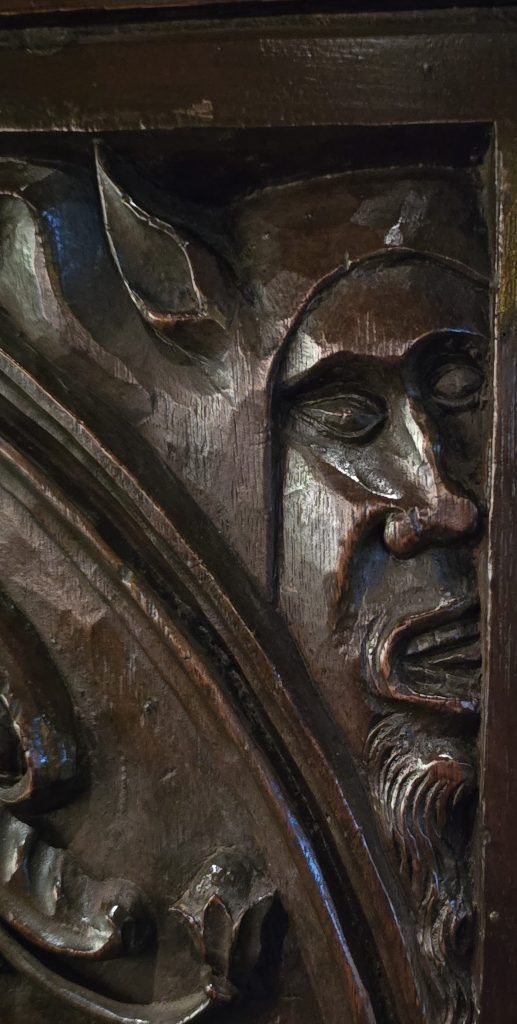
At the top on either side of the arch just under the top rail, two bearded faces with pointed ears peer out to the right and the left, as if they are watching and listening to what is being said in the room. Their pointed ears suggest they are not human, but represent demons tasked with recording the idle gossip, vanity, lying, usury, pride and fornication of the people in the room where the throne is placed. Such a demon is Titivullus who appears in many illuminated manuscripts carrying his evidence in a sack so it can be presented on the Day of Judgement. These carved representations are there to remind the audience they were in the presence of God’s anointed earthly representative.
Within the top of the arched area are two serpents whose long tongues end in a curl. They emerge from stylised foliate decoration, while below them two naked humans hold a shield containing two carved initials linked by a cord.
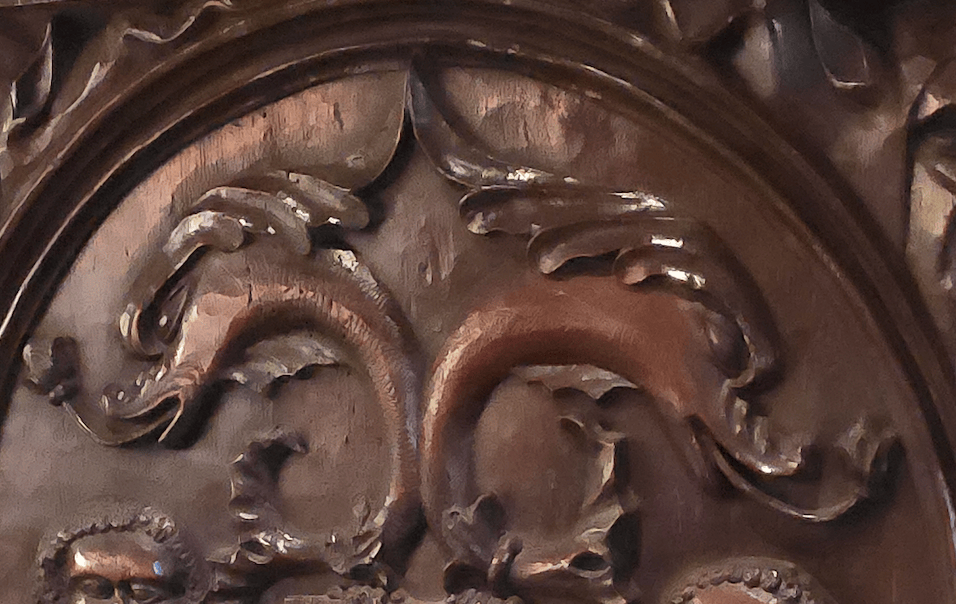
The Hever catalogue suggests these are four dolphins.
Pliny the Elder described dolphins as having dorsal fins. His observations of serpents is contained in detail in Book 8 of his Natural History, while that of fish, including dolphins, in Book 9.[vii] However, it is likely the carvers tasked with creating these four emblematic beasts probably worked from templates taken from a bestiary. This link will take you to twenty five images of the various types of dolphins that were originally thought to be fish. https://bestiary.ca/beasts/beastgallery284.htm. All examples have dorsal fins, rounded bodies and in some instances, teeth. Nowhere in any of these ancient books are dolphins depicted with long tongues or as being sinuous in shape, whereas there are many different serpents listed by individual names in works by philosophers writing long before the birth of Christ through to the medieval creators of the bestiaries.
Book 1 of Ovid’s Metamorphoses, describes how the sun-god Apollo came to Delphi and found it guarded by Python, a giant snake protecting the site of worship of the older goddess, Gaia, who was of the first generation of Greek gods, and personification of Earth. The Greeks believed the centre of the earth was at Delphi and guarded by the serpent Python. The Landsdowne throne depicts the slaying of Python, and having killed the serpent Apollo established his own centre of worship and was worshipped by the Greeks and later adopted by the Romans.
The Old Testament book of Numbers Chapter 21 verses 4-9 describes the story of the fiery serpents sent by God while Moses was leading the Israelites out of Egypt.[viii]
4. And they marched from mount Hor, by the way that leadeth to the Red Sea, to compass the land of Edom. And the people began to be weary of their journey and labour:
5. And speaking against God and Moses, they said: Why didst thou bring us out of Egypt, to die in the wilderness? There is no bread, nor have we any waters: our soul now loatheth this very light food.
6. Wherefore the Lord sent among the people fiery serpents, which bit them and killed many of them.
7. Upon which they came to Moses, and said: We have sinned, because we have spoken against the Lord and thee: pray that he may take away these serpents from us. And Moses prayed for the people.
8. And the Lord said to him: Make a brazen serpent and set it up for a sign: whosever being struck shall look on it, shall live.
9. Moses therefore made a brazen serpent, and set it up for a sign: which when they that were bitten looked upon, they were healed.
In the New Testament St John uses the Old Testament story to describe the Resurrection and the promise of salvation for those who follow Christ’s teachings.
14. And As Moses lifted up the serpent in the desert, so must the Son of Man be lifted up.
15. That whosoever believeth in Him may not perish, but may have life everlasting.[ix]
By the medieval period the snake had become an allegory reminding Christians that just as the snake sheds its skin, they must give up any sinful habits in order to find salvation. The snake’s venomous element was used as a reminder that before attending Mass the faithful should attempt to rid themselves of evil thoughts. It was also believed that a snake would flee from naked humans, but not from clothed individuals. The reason being that the snake recognised that before eating from the tree of knowledge Adam and Eve had been naked, therefore a clothed individual was sinful, but a naked person not.
A carved flower sprouts from where the two lower serpents meet and rises to knee level of the two carved figures. Pliny is effusive in his description of the rose being a species of flower cultivated by the Greeks and Romans.[x]
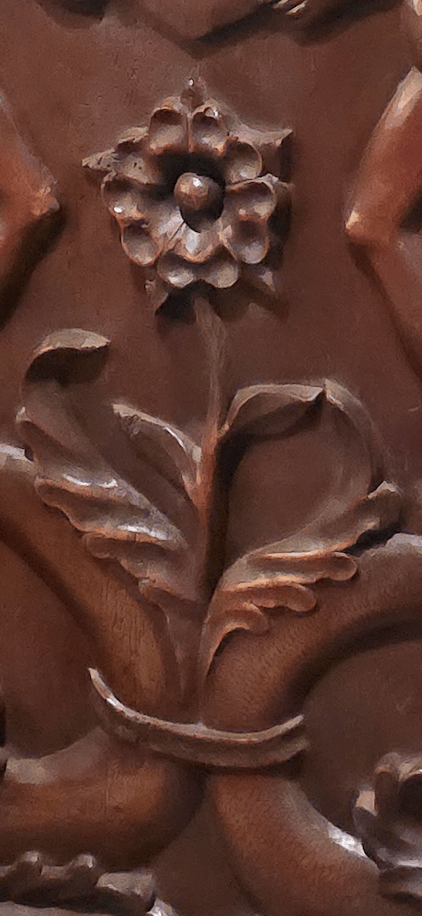
As well as being the emblem of the Greek goddess Aphrodite, the rose is also that of the Virgin Mary. Many illuminated manuscripts and altarpieces contain images of the Virgin with both white and red roses, white representing faith and purity, and red symbolising love and sacrifice. Below is Stefan Lochner’s Madonna of the Rose Bower depicting both white and red roses surrounding the Virgin Mary.
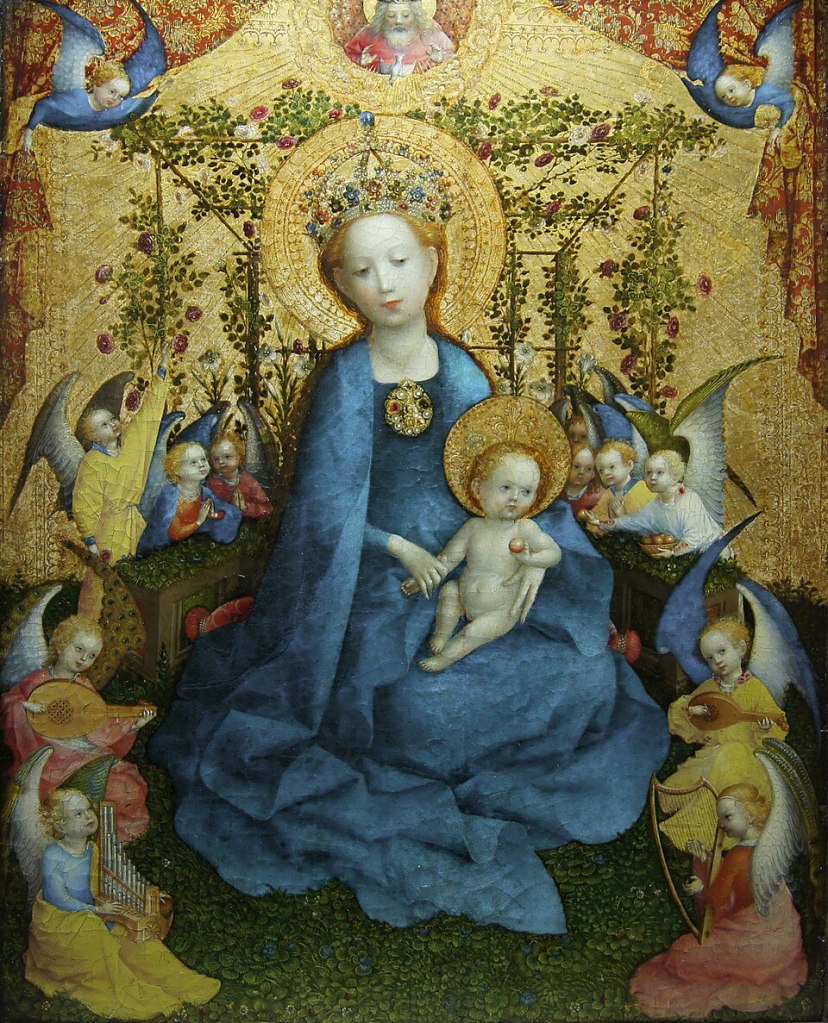
Source: Wikipedia
Louis XII of France had adopted the Virgin Mary as his divine representative in honour of his mother Marie of Cleves (1426-1486). Marie was third wife of Charles Valois, Duc d’Orleans (1391-1465), thirty two years older than his bride, and Louis was born in 1462 twelve years after the marriage.
The rose is described as being a Tudor rose in the Hever catalogue with little cognisance taken of the vast number of surviving examples of both the white and red varieties of the rosa gallica appearing in books of hours, altarpieces and other works as emblems of the Virgin.
As a deeply religious man Henry VII would have been aware of the significance of the red and white roses and their association with the Virgin Mary, as well as their being the emblems of the Houses of Lancaster and York when he combined the two to create what we know today as the Tudor Rose. The Henry VII chapel in Westminster Abbey is a spectacular example of late Gothic architecture. Building started in 1503 and it was finally finished six years after Henry’s death. Originally the chapel was called the Lady Chapel and like other Lady Chapels was dedicated to the Virgin Mary adding a further layer of meaning for Tudor scholars to ponder the reasoning behind Henry’s decision to combine the red and white roses of Lancaster and York.
At first glance, the two naked humans appear androgynous, but on closer inspection the figure on the left has a beard. Unlike Adam in the Ghent altarpiece he has no fig leaf covering his genitals so his beard is the only clue as to his gender. The figure on the right has raised breasts, and rounder facial features and together they represent Adam and Eve, who hold a shield showing the two upper case initials ‘A’ and ‘L’, held together by a cord.
The presence of Adam and Eve, the Virgin’s rose, and the watchful demons confirms this is a cathedra-style chair created for a person anointed to be God’s earthly representative whose name begins with either the initial ‘A’, or ‘L’.
However, to unravel just who this individual was, we have to this we have to consider the early history of Italy and the attempt of Emperor Otto III to unite the Holy Roman and Byzantine empires by marriage at the beginning of the eleventh century.
Adelaide of Italy (931-999CE) was married to Emperor Otto the Great (912-973 CE) and together they ruled the Holy Roman Empire as emperor and empress until Otto died in 973 CE. Their three-year-old grandson, Otto III inherited the position in 996 CE on the death of his father Otto II. When Otto III reached his majority in 994 CE he re-established imperial control over Rome, ousted the aristocrat who had led a rebellion against the Holy Roman Empire and installed his cousin, Bruno of Carinthia, as Pope Gregory V who crowned Otto III, emperor.
As an expansion of imperial influence Emperor Otto III sent diplomats to negotiate marriage to Zoë the second daughter of Emperor Constantine VIII (960-1028) who ruled the Byzantine empire jointly with his older warrior brother Basil II (958-1025). As part of the marriage negotiations the Byzantine emperors presented Otto with a Holy relic being a statue of a serpent mounted on a pillar allegedly made by Moses as described in the Book of Numbers.
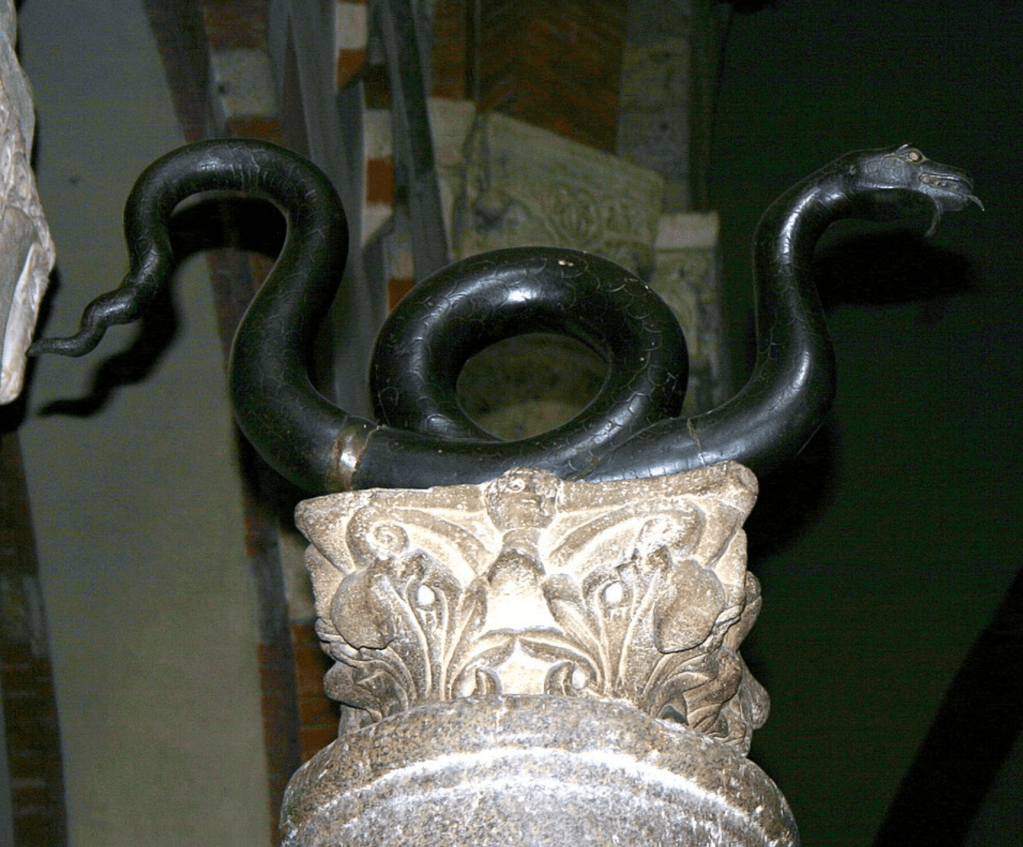
Image Source: Wikipedia.
However, when the twelve year old Zoë arrived in Italy she found the twenty-one year old emperor had died so she returned to Constantinople, but the relic of Moses’s serpent remained in the city of Milan and was adopted by the municipal authorities as its emblem, together with a Red Cross.
The Italian historian and writer, Dario Scaramazza, tells how the area around Milan had many legends of dragons and snakes, and that prior to 1395 the municipality of Milan was represented by a military banner of a biscione with a red cross on a white background.[xii]
After 1395 the ‘communal liberties’ of the city were abandoned and the Visconti family created dukes of Milan. They took the original military banner with the ‘biscione’ and replaced the red cross with a red figure emerging from the serpent’s mouth.[xiii] The Visconti ruled Milan for two centuries until Bianca Visconti, the illegitimate heir of Duke Filipo Maria Visconti, was married to the powerful condottiere (today’s equivalent is a mercenary), Francesco Sforza, in 1441.
Visual evidence of the French claim to the Duchy of Milan in the fifteenth century be seen in the coat of arms of Charles VIII as Duc d’Orleans.
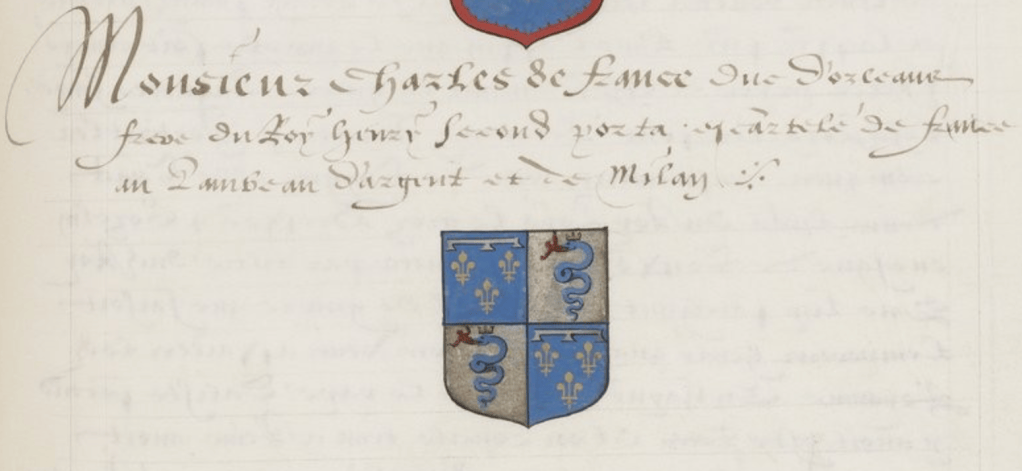
Recueil des rois de France by Jean Tillet (1500-1570). Illuminations Master of Henri II. 1566
© Bibliothèque nationale de France. Département des Manuscrits.
Charles’s Italian campaign was undertaken from 1494 to the following year and after his foray into Lombardy he quartered the coat of arms of the Dukes of Milan, with those of France.[xiv]
Louis XII’s interest in Milan was personal. In 1398 his grandfather, Louis Duc d’Orleans (brother of Charles VI of France) had married Valentina the daughter and last surviving legitimate child of the last male the last male Visconti duke, Filippo Maria. The Milanese duke died in 1447 and the condottiere, Francesco Sforza , seized Milan and proclaimed himself Duke, having previously married Bianca Maria Visconti – the illegitimate daughter of Fillipo Maria. However, Sforza’s claim was not recognised by Holy Roman Emperor Frederick III so there was no investiture, which would have legitimised Sforza’s claim. Louis XI succeeded to the French throne in 1461 and maintained a neutral, possibly even friendly position with Francesco Sforza, so it was only after the French king’s death that Louis XII able to take the territory he believed was his by right.
Having gained Milan on 6th September 1499, Louis added the ‘biscione’ alone to his other emblems, having rejected the red figure emerging from the serpent’s jaws, being the emblem created for Sforzas he believed had usurped his grandfather’s rightful inheritance to the duchy.
In 1521 the French forces were driven out in by Emperor Charles V and the Sforza family reinstated. Duke Ludovico Francesco Sforza II died in 1535 without an heir and the duchy reverted to the emperor who in 1540 made his son, the future Philip II of Spain, Duke of Milan.
The Shield with the Carved Initials & Cord
Contrary to what looks like a lower case ‘b’ in the photograph, when standing in front of this ‘chair’ it is obvious the letter is an upper case ‘L’. The two upper case initials, together with the iconographical emblems representing Adam and Eve, the rose of the Virgin Mary and the serpent of Milan, defines the initial ‘A’ stands for Anne of Brittany, and the ‘L’ references her husband, King Louis XII of France.
The knotted rope linking the two initials represents the Ordre de la Cordelière and is a specific reference to her rank as Duchess of Brittany. Anne’s step-grandfather, Francis I of Brittany added a knotted cord to his arms as homage to his patron saint, St Francis of Assisi, and Anne’s father, Francis II, had continued the tradition.
Brittany was of strategic importance to both the Holy Roman Empire and to France making it inevitable that, as sole heir to the duchy, Anne was required to make a dynastic marriage. The first of three was by proxy to Maximillian, King of the Romans, but the couple never met and at the age of 14, in 1491 Anne renounced that marriage and married the teenage Charles VIII of France (1470-1498) on 6th December 1491.
Her first coronation and anointing took place in Paris at the basilica of St Denis on 8th January 1492. Charles VIII’s father, Louis XI, had died in 1483, and since the new king was yet to reach his majority France was ruled by his older sister as regent, confusingly also named Anne. Her father had described his daughter as the most intelligent woman in all of France and she and her husband, Peter de Beaujeu, ruled France very successfully winning the three year Mad War (aka La Guerre Folle) in 1488, being a rebellion of nobles that had included Louis Duc d’Orleans – heir to the French throne should the young Charles VIII die without a male heir.
In 1498 Charles VIII returned to Château Amboise from hunting apparently banging his head on the lintel as he walked through a low door, and died as a result. The couple had been married for seven years and Anne had been pregnant for most of that time. Unfortunately, no child had survived and according to the marriage treaty of 1491, and to keep Brittany within French control, the widowed Queen Anne was to be married to the next in line to the throne, who was Louis, Duc d’Orleans. A major impediment to this union was that Louis was already married to King Charles’s severely disabled sister, Joan of France.
After gaining an annulment from his first marriage from Pope Alexander VI on the grounds of non consummation (which Joan denied), Louis married Anne, Dowager Queen of France and Duchess of Brittany suo jure on 8th January 1499, yet her second anointing as queen of France at St Denis did not take place until 18th November 1504.
During her first marriage Anne had spent time at various châteaux including those of Amboise and nearby Clos Lucé, the latter having been a refuge when Charles VIII’s Italian builders were renovating Château Amboise.
After her marriage to Louis in January 1499 Anne spent time at Château Royal de Blois – also situated in the Loire region. The château then became the royal residence of choice and the centre of political power.
Louis XII and Queen Anne were very aware of the power of imagery, and various examples survive demonstrating how the placing of their initials reinforced their divine right to rule in the minds of the people.[xv]
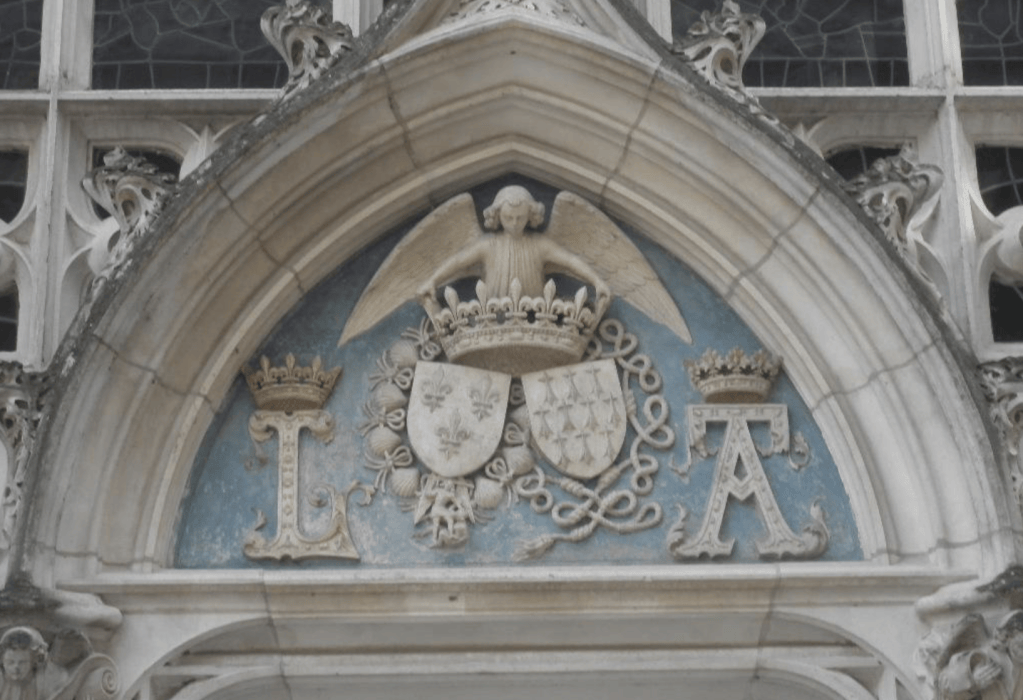
Image source: Wikipedia
A surviving architectural statement of their successful co-rule can still be seen on the gable of the chapel at Château Royal de Blois. These are the ‘L’ and ‘A’ carved in stone, on a blue ground. These initials are the same as they appear on folio 2r in an illuminated manuscript by Fausto Andrelini, (BnF Ms Lat. 8395). The crowned intials of Louis and Anne flank their coats of arms. Louis’ coat of arms is surrounded by the Order of St Michael and the Order de la Cordelière surround Anne’s.
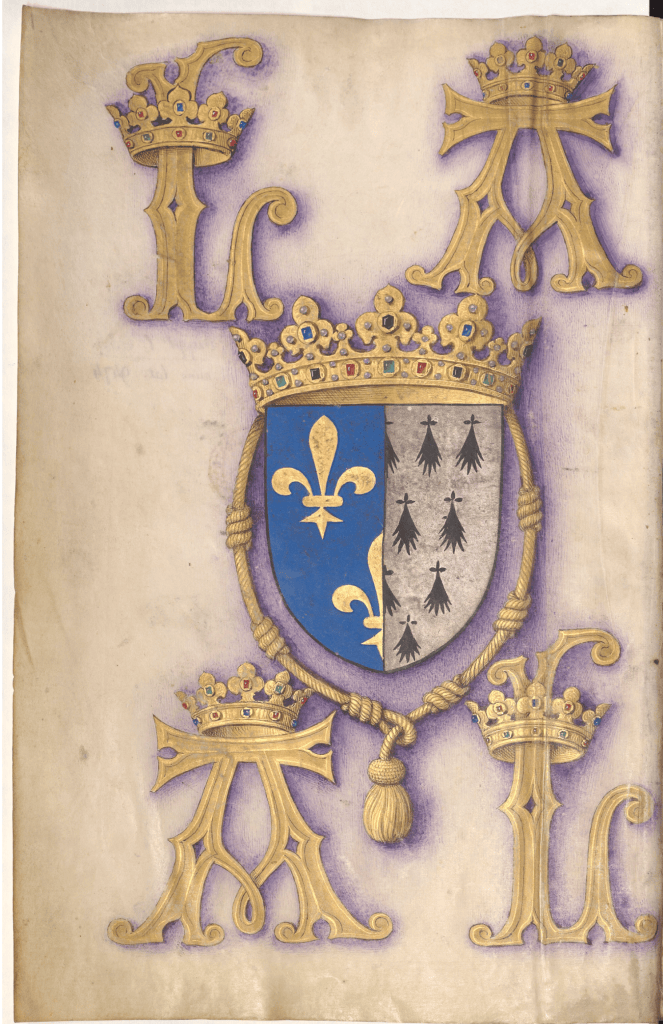
There are four crowned initials of Louis XII and Queen Anne’s on folio 1v in a magnificent book of hours known as Les Grandes Heures d’Anne de Bretagne. The two ways the initials are placed demonstrates their order is interchangeable.
The combined coats of arms are embraced by Anne’s cordelière.
Département des Manuscrits;
BnF Ms Latin 9474
The arms of France and Brittany surrounded by Anne’s cordelière is a visual expression of her status as both queen of France and Duchess of Brittany. The entwining of the cordelière in the shield carved in the back panel of the Hever chair unites the royal couple in a similar way.
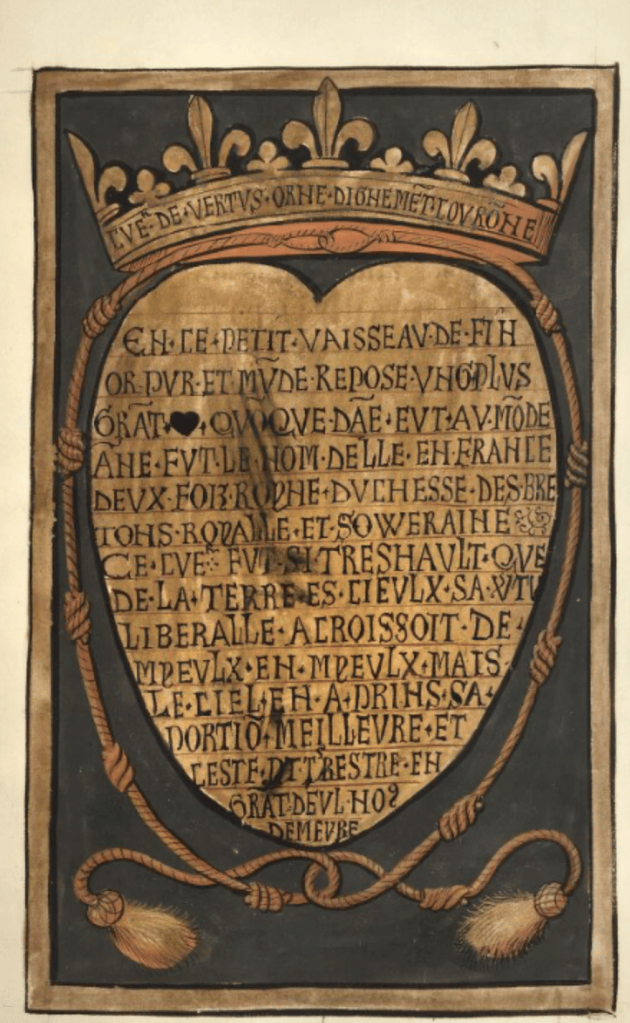
Anne died on 9th January1514 some days after giving birth to a stillborn son, and Louis instructed her faithful Breton retainer, Pierre Chocque, to create books recording Anne’s funeral and interment and to have the major parts of the ceremony depicted as full page illuminations.
Anne’s actual heart is encased in a gold reliquary held in the Musée Départmental de Thomas Dobrée in Nantes since the nineteenth century. It also appears as a full page illumination (below) in Pierre Chocque’s commemoration of the queen’s funeral.
Princess Claude inherited the title of Duchess of Brittany, but French law required the French throne to go down the male line so she was married to her cousin, François d’Angoulême on 18 May 1514.
In an attempt to secure a male heir thus preventing the throne devolving to his son-in-law, Louis married for the third time in September 1514, this time to Princess Mary, sister of the English king Henry VIII. Louis died three months later without his new queen becoming pregnant and in accordance with Sallic law, Princess Claude’s husband, François d’Angoulême, became king of France as François I.
Claude died in 1524 having produced two sons, François and Henry, who survived to adulthood. The Dauphin François inherited the duchy of Brittany on his mother’s death, but did not live to inherit the French throne as he died in 1538. His younger brother Henry then became both Dauphin and Duke of Brittany and inherited the French throne as Henry II in March 1547 on the death of his father, François I.
Conclusion
The use of upper case initials ‘A’ and ‘L’ on this cathedra-style ‘chair’, and in other examples of French art, architecture and illuminated texts, is a demonstration of the King Louis XII and Queen Anne’s use of imagery and initials to promote their divine right to rule as absolute monarchs, having been anointed as God’s earthly representatives in their separate coronations.
It is probable this throne was once one of a pair, in which case King Louis’ throne would have had similar initials entwined with a cord, with his upper case ‘L’ coming before Queen Anne’s ‘A’. In all other respects the king’s throne would have had similar carvings, with the four serpents representing the ‘biscione’ of Milan, the duchy Louis XII claimed was his by right through his grandfather’s marriage to Valentina, the legitimate heir to Duke Filipo Maria – the last duke of the Visconti family.
Brittany finally became just another duchy of France when Dauphin Henry became Henry II of France in 1547 and Anne of Brittany’s personal emblem of the cordelière was absorbed as another emblem of France.
Considering the plethora of the emblems used by Louis XII and Queen Anne, the tight etiquette of who could sit or stand in the presence of French monarchs, and the total absence of any emblems pertaining to the Boleyn family, it is hard to believe why anyone would consider this exquisite throne had been created for the teenage daughter of a man who did not acquire any titles from Henry VIII until 1525.
§
Acknowledgements:
My grateful thanks to Dr Jonathan Foyle for taking time for a conversation regarding the use of visual symbolism in art, manuscripts and architecture and to Dr Jo Wilkinson for her ongoing support.
Footnotes
[i] Emmerson, Owen & Kate McCaffrey; Capturing a Queen: The Image of Anne Boleyn; exhibition catalogue; Hever Castle & Gardens; 2026 pp37-38.
[ii] www.westminster-abbey.org/history/explore-our-history/the-coronation-chair [29/10/2026]
[iii] The Lansdowne throne was acquired for the Marquess of Lansdowne by the artist Gavin Hamilton (1723-17998), who had a shady sideline in acquiring Italian antiquities for the gentry. Just where Hamilton acquired it from is unknown. The throne was acquired by William Randolph Hearst in the 20th century.
[iv] My thanks to Dr Josephine Wilkinson for her recommendation and discussion of Brocher’s book on French etiquette.
[v] Capturing a Queen; Hever Castle 2026 exhibition catalogue; pp37-38.
[vi] https://www.britannica.com/topic/dauphin-French-political-history [02/10/2026]
[vii] Pliny the Elder; Natural History. Book 8 Sections 85-89 is Pliny’s general entry on serpents. Section 139 is specifically on vipers. See Sources for the translated online copy [03/06/2026]
[viii] The Vulgate Bible; www.vulgate.org [02/06/2026]
[ix] The Gospel of St John; The New Testament Chapter 3 v14-15.
[x] Pliny; Natural Histories; Book 21
[xi] This beautiful fifteenth century panel is now in the Walraf-Richartz Museum, Cologne.
[xii] Scarimazzo, Dario; The Visconti Serpent. The Brescia Libraries and Heraldic Invention; pps 9 and 13. ‘Biscione’ is Italian for viper, or large grass snake.
[xiii] Holy Roman Emperor Wenceslaus of Luxembourg created the Sforza ducal line in 1395.
[xiv] Scheller, Robert; “Imperial Themes in Art and Literature of the Early French Renaissance: The Period of Charles VIII.” Simiolius. Netherlands Quarterly for the History of Art 12, No 1 (1981): 5-69. https.//doi.org/10.2307/3780518: p18.
[xv] Scheller, Robert; “Ensigns of Authority, French Royal Symbolism in the Age of Louis XII.” Simiolus: Netherlands Quarterley for the History of Art, Vol 13, no. 2 1983 translated from the original Dutch by Michael Hoyle
Sources & Further Reading.
Original documents
De St Marie, Anselme, & Honoré Caille du Fournay; Histoire généalogique et chronologique de la maison royale de France, des pairs, grands officiers de la couronne & de la maison du Roy, & des anciens barons du royaume …; Paris. 1728. pp139, 445-467.
Bourdichon, Jean (1457?-1521); Horae ad usum Romanum, dites Grandes Heures d’Anne de Bretagne; 1503-1508. BnF: Département des Manuscripts Latin 9474 [last accessed 14/10/2026]
Boysset, Bertrand (1350?-1415)“Recuil de Copies de pièces portent pour titre : Ceremonies observées aux enterremens des rois, prince et grands; BnF Départements des Manuscrits Français 4317;
Chocque, Piere; Commémoration et avertissement de la mort d’Anne de Bretagne; BnF Départements des Manuscrits Français 18537. Paris. 1514-1515 [10/10/206]
du Tillet, Jean;Recuil des rois de France (premier version); BnF Départements des Manuscrits Français 2854; Paris. 1553-1555.
Recuil des Rois de France 1545-47. Text Jean du Tillet (1500-1570); BnF Department des Manuscrits Français 12148 [last accessed 01/10/2026]
Ovid; Metamorphoses; David Raeburn (trans.) Penguin Classics; 2004.
Pliny the Elder – Naturalis. www.Attalus.org [03/06/2026]
The Ghent Altarpiece: https://www.sintbaafskathedraal.be/en/history/the-ghent-altarpiece/ [last accessed 26/10/2026]
Illuminated manuscripts accessed via The Medieval Bestiary Website: https://bestiary.ca/contents.htm [last accessed 26/10/2026]
Aberdeen Bestiary (Second Family); Univ. Lib. 24; Aberdeen University; Aberdeen, Scotland. C1200
Brehaut, Ernest; An Encyclopaedist of the Dark Ages: Isidore of Seville; Columbia University Studies in History, Economics and Public Law; 1912, series 48. Reprinted 1972 by Burt Franklin Reprints, New York.
Aristotle; Aristotle’s History of Animals in Ten Books; Richard Cresswell (trans.) George Bell, London 1887.
Ashton, John; Curious Creatures in Zoology; Cassel Publishing, New York; 1890. Digital resource (Project Gutenberg).
Collins, Arthur; Symbolism of Animals & Birds represented in English Church Architecture; McBridge, Nast & Co., 1913. [last accessed 27/10/2026]
Jacob van Maerlant (1235?-1300); Der Naturem Bloeme; Koninklijke Bibliotheck KB, KA 16; & Koninklijke Bibliotheck KB 76 E4.
Thomas of Cantimpre (1201-c1272); Liber de Naturen Rerum (Book on the Nature of things) Books 7 & 8 being on fish and serpents respectively.
Von Bingen, Hildegarde; Physica; BnF Departements des Manuscrits lat. 6952; Paris. Late 15th century.
Secondary Sources
Baumgartner, Friedrich; Louis XII; St Martin Press; 1996
Brocher, Henri; Le Rang et l’Etiquette sous l’Ancien Régime; Librairie Felix Alcan, 1934
Broomhall, Susan, editor. Women and Power at the French Court, 1483-1563. Amsterdam University Press, 2018. JSTOR, https://doi.org/10.2307/j.ctv8pzd9w. [7 May 2026].
Boudon-Machuel, M. & P. Charron (2016). Figurative Art of the Loire Valley through the Prism of the Digital Humanities: ARVIVA and Sculpture 3D Projects. Actual Problems of Theory and History of Art, 6, 425–432.
Collins, Paul; The Birth of the West; published in the US by Public Affairs a member of the Perseus Book Group; 2014.
David-Chapy, Aubrée. “The Political, Symbolic, and Courtly Power of Anne de France and Louise de Savoie: From the Genesis to the Glory of Female Regency.” Women and Power at the French Court, 1483-1563, edited by Susan Broomhall, Amsterdam University Press, 2018, pp. 43–64. JSTOR, https://doi.org/10.2307/j.ctv8pzd9w.4 . [07/05/2026]
De la Warre, Catherine; A Twice Crowned Queen, Anne of Brittany; Eveleigh Nash, London1906. New edition Nostalgia Books 2025.
Emmerson, Owen & Kate McCaffrey; Capturing a Queen: The Image of Anne Boleyn; exhibition catalogue; Hever Castle & Gardens; 2025
Hamburger, Jeffrey F, Wiilliam P. Stoneman, Anne-Marie Eze, Lisa Eagin Davis & Nancy Netzer (editors); Beyond Words: Illuminated Manuscripts in Boston Collections; McMullen Museum of Art, Boston College; distributed by University of Chicago Press; 2016.
Hess, Rick; Take a Seat: History of Chairs and the Evolution of Chairs; Design Institute of Chicago; 23/10/2014; https://www.disd.edu/blog/take-seat-exploring-chair-throughout-history/ [04/06/2026]
Ives, Eric; The Life & Death of Anne Boleyn; Wiley Blackwell; 2005.
Kren, Thomas & Mark Evans (eds); A Masterpiece Reconstructed : The Hours of Louis XII; J.. P Getty Museum and The British Library in association with the Victoria and Albert Museum; 2005
MacDonald, Sir John C.B. LL.B. & Edward Manson (eds); Great Jurists of the World;https://archive.org/details/in.ernet.dli.2015.13326/mode/1up %5B01/06/2026%5D
Palmer, James; The Merovingian Things 2: The Throne of Dagobert http://www.merovingianworld.com [10/05/2026]
Scaricamazza, Dario; The Visconti Serpent. The Brescia Libraries and Heraldic Invention; translated from Il Biscione dei Visconti. La Lipsanoteca di Brescia e l’invenzione araldica; 2023; Academia.edu [30/05/2026]. See also https://scaricamazza.com.
Scheller, Robert W; “Ensigns of Authority: French Royal Symbolism in the Age of Louis XII.” Simiolus: Netherlands Quarterly for the History of Art, vol. 13, no. 2, 1983, pp. 75–141. JSTOR, https://doi.org/10.2307/3780504 [07/05/2026]
“Imperial Themes in Art and Literature of the Early French Renaissance: The Period of Charles VIII.” Simiolus: Netherlands Quarterly for the History of Art 12. No. 1 (1981): 5-69. JSTOR https://doi.org/10.2307/3780518 [Accessed 25/05/2026]
Sterling, Charles; The Master of Claude, Queen of France : A Newly Defined Miniaturist; J.P. Kraus, New York; 1975.
Westminster Abbey website; https://www.westminster-abbey.org/history/explore-our-history/the-coronation-chair
Wilkinson, Josephine; Anne Boleyn: The Young Queen To Be; Amberley; 2011.


