During Covid I was asked to examine an artefact that had been bought in a private sale. The owner had their own thoughts when it came to the interpretation of the repoussé work in the lid, which has no bearing whatsoever to any motif in any emblem book created in the sixteenth century. What was apparent from the outset was the lack of provenance due to what the middleman was permitted to tell his buyer..
What follows is my research and interpretation of the item and the symbols portrayed in the lid.
Could this pot have belonged to Mary Queen of Scots?
This artefact was bought in a private sale and the vendor wished to remain anonymous. The middleman was limited in what he was permitted to tell any prospective buyer, except to say that the object had been in the same family since the mid 16th century and the family was a prestigious one.
Originally described as belonging to Mary Queen of Scots this unusual item is made of turned lignum vitae and shaped like a Chinese ginger jar.
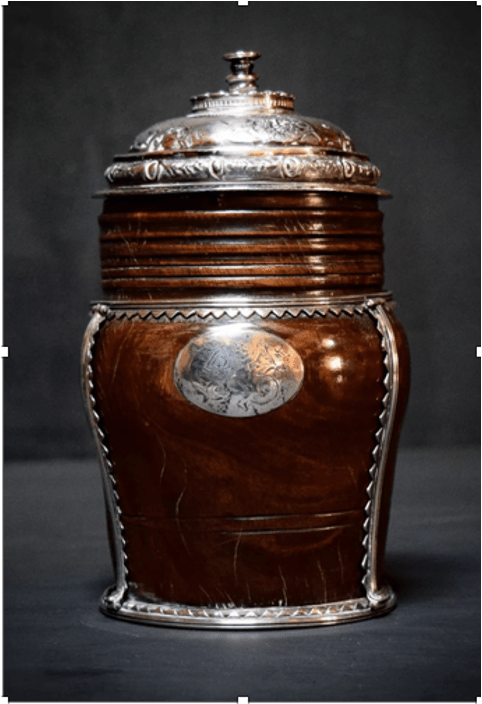
Lignum vitae is a species of wood that might have been imported from the tropical rainforests of the New World from the beginning of the sixteenth century. However, a separate species, Vitex lignum-vitae, is found in New Guinea and in eastern Australian from the Richmond River in New South Wales to the tip of the Cape York peninsula, which was allegedly only discovered by Capt. Cook in the late eighteenth century.[i], [ii] The name translates as ‘wood of life’ and legend has it that Christ’s cross was made of this wood, which might be why it was called lignum vitae as its holy victim was the Saviour of Mankind. Today, both species are listed on the CITES list of endangered species, with the Australian tree being listed in 1975 and the South American one in 2005.[iii]
The base of this wooden pot has a scratched effigy of a woman with flowing hair standing within a laurel wreath and crowned with a five pointed coronet. Quartered rectangles are depicted in the band of the coronet represent diamonds, symbols of constancy. The woman holds three stems of flowers each having five petals. The three stems may reference The Trinity, and the five petals the five wounds of Christ. The flowing hair suggests a virgin, and laurel wreaths date back as far as ancient Greece as emblems of success.
Mary Stuart fled Scotland in 1568 and arrived in England with nothing. She was to spend the next decade and a half as the ‘guest’ of George Talbot, 6th Earl of Shrewsbury and his third wife, Bess Cavendish (née Hardwick), during which time three major plots against were uncovered to remove Elizabeth I from the throne and replace the queen with Mary Stuart. If this wooden pot once belonged to her did it come into her possession during her years with the Earl & Countess of Shrewsbury?
Was it given as a gift to the Scottish queen, or did she commission it herself to give as a gift?
The symbolism of the repoussé work.
It has a silver lid with repoussé decoration and the sides are decorated with three oval plaques separated by silver strapwork.
Both the lid and plaques are much worn with polishing and there is some damage to the wood near the base of the wooden pot.
The work of Scottish goldsmiths, James Cockie, James Mosman, both executed in 1573 for treason, have been identified as having made items owned by Mary Stuart, and for raising funds for her with her jewellery used as collateral. George Heriot, the third goldsmith, survived.[iv] Equally there are French or English goldsmiths who may have created the silverwork, except the maker’s and assay marks are too worn to be deciphered thus making identification impossible.
At the beginning of the sixteenth century a number of books of devices and imprese were composed depicting various motifs, or scenes, accompanied by various mottoes and poems.[v] It was not until 1551 and 1557 when Claude Paradin published his books of imprese that further ideas for expressing coded images emerged and inspired many of the scenes seen in the various embroideries done by Mary Stuart when she was lodged with the Earl and Countess of Shrewsbury [vi],[vii],[viii].
In 1574 Bess married her daughter Elizabeth (by her second husband, William Cavendish), to Mary Stuart’s brother-in-law, Charles Stuart, Earl of Lennox, an ambitious move since any child of this marriage had a claim to the English throne via Charles’ grandmother, Lady Margaret Douglas (1515-1578). Elizabeth and Charles’ daughter, Arbella Stuart was born in 1575 and Mary Stuart refers to Arbella in a letter as Bess’s niece.[ix]
The imagery of the three Plaques:
Simple silver strapwork adorns the sides and base together with three oval plaques containing three different scenes.
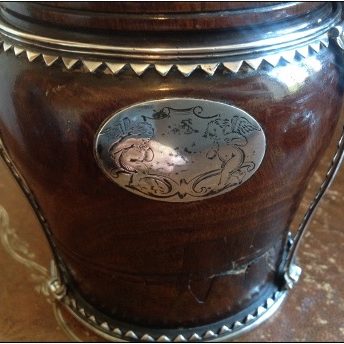
cartouche worn by polishing.
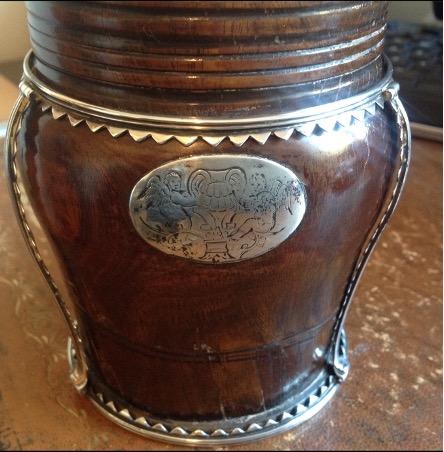
The first of the three oval plaque’s depicts two winged cherubs holding a cartouche. This may have once contained a coat of arms, but now only the outline is visible. A second plaque also has two winged cherubs, this time placed either side of what may be a sculpture.
No similar imagery to this plaque has yet been found in any books.
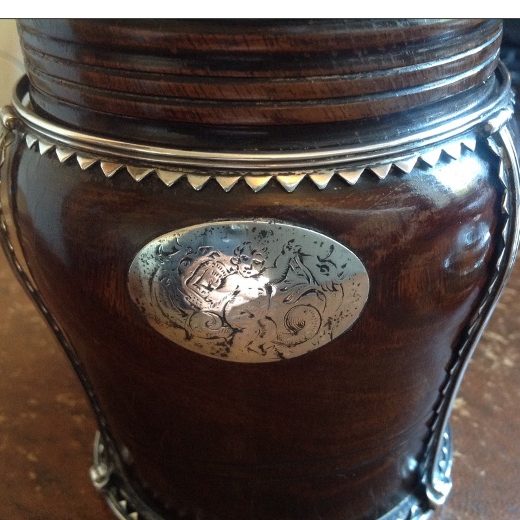
A single wingless cherub sits between two mythical beasts in the third. This cherubic child may represent Mary’s son, James VI of Scotland, grappling the two thrones of England and Scotland, since King James VI of Scotland also had a claim to the English throne by blood through his grandmother Lady Mary Douglas (1515-1576) daughter of Henry VIII’s sister Margaret Tudor, wife of James IV of Scotland despite this line being specifically ruled out in Henry VIII’s 3rdAct of Succession of 1543.
An examination of the many various books of imprese dating from the early sixteenth century are equally void of cherubic imagery such as those seen in these three plaques.
The Man of Sorrows
The silver lid is decorated with the heads of three weeping men contained within three triangles, bringing to mind Isaiah Chapter 53 v3-4.
3) He is despised and rejected of men, a Man of sorrows, and acquainted with grief. And we hid as it were our faces from Him; He was despised, and we esteemed Him not.
4) Surely He hath borne our griefs and carried our sorrows; yet we did esteem Him stricken, smitten of God, and afflicted.
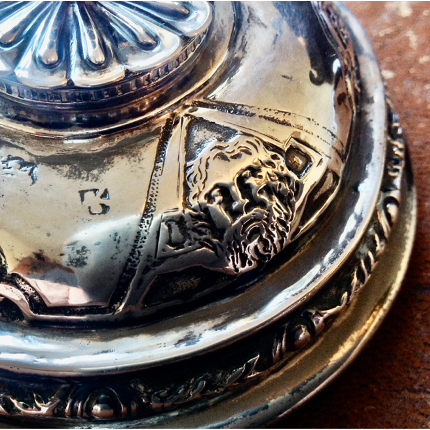
Such specific decoration would have required a conversation between the patron and a silversmith who was also au fait with humanist symbolism regarding numbers.
According to Henricus Cornelius Agrippa (1489-1535) the number three is one of the major numbers and references “… three Princes of the world, Oromasis, Mitris and Araminis being God, the mind, and the spirit as well as “Three theological virtues – faith, hope and charity” [x] It was not the first time a monarch had used the image of Isaiah’s Man of Sorrows to make a personal statement.
In 1532/33 Mistress Boleyn had chosen an illumination of The Annunciation in her personal book of hours to write a message as follows: Be daly prove you shall me fynde / To be to you bothe lovynge and kynde.[xi]
Henry VIII’s response, in French, was made under the full-page illumination of The Man of Sorrows ‘Si selon mon affection la suficnaire sera voz prieres ne scram yezs opic car je sus Henry Jamays‘ which translates as ‘If you remember my love in your prayers as strongly as I adore you, I shall hardly be forgotten, for I am yours. Henry forever.’[xii]
Anne’s choice of image suggests she was informing Henry she was pregnant. Therefore, her note had to have been written after she had missed her period approximately 40 weeks before the birth of Princess Elizabeth on 7th September 1533.
The words ‘I shall hardly be forgotten for I am yours, Henry forever’, can be interpreted in at least two ways. Taken at face value Henry appears to be swearing undying love to Anne. A more nuanced interpretation requires Henry’s words to be considered in relation to the image, in which case he is showing his delight that his lover is pregnant with his long awaited (male) heir.
What we have to consider about the use of this image on this pot is that only an anointed monarch would have the audacity to use the image of the Man of Sorrows as a personal emblem.
The scratched image on the base:
In 1574 Bess’s daughter, Elizabeth Cavendish (1555-1582) married Charles Darnley (1557-1576) and a year later a daughter, Arbella, was born. Charles died in 1576 and Elizabeth in 1582. The orphaned Arbella therefore came under the jurisdiction of the Court of Wards and wardship was granted to her grandmother, Bess of Hardwick. Through Elizabeth Cavendish’s marriage to Charles Darnley Arbella, also had a claim to the English throne. In which case does the scratched image on the base refer to Arbella?
In 1603 two plots were discovered to place Arbella Stuart on the throne in place of King James VI/I of Scotland & England. The first conspiracy was called ‘The Main Plot’ and allegedly put together by Henry Book, 11th Lord Cobham (1564-1618). The plotters of the second, The Bye Plot, was a disparate group of Catholic priests and Puritans. The Main Plot was found to have been sponsored by Spain, but the motivation of the Bye Plot conspirators is unclear since Catholic and Puritan theology is very different.
In 1610 Arbella secretly married William Seymour, 2nd Duke of Somerset, who was some thirteen years her junior. Seymour had a claim to the English throne via his grandmother, Katherine Grey and her relationship with Edward Seymour, 1st Earl of Hertford. Under Henry VIII’s 1543 Act of Succession the Tudor line was supposed to descend through the Grey family which, on the surface, gave William Seymour his claim to the English throne through his grandmother Katharine. The union between Katharine Grey and Edward Seymour had been discovered in 1561 when a visibly pregnant Katharine admitted to Sir Robert Dudley to having married Seymour without the Queen’s permission. Since no witness could be found, William Cecil had the marriage declared void, therefore making any child of theirs illegitimate.[xiii] The couple were incarcerated in The Tower, but still found a way to consummate their marriage once more, resulting in a second son.
While the illegitimacy of Katharine and Edward’s sons may have precluded them from the English throne during Elizabeth I’s lifetime, but after the queen’s death there were others who believed Katharine and Edward’s grandson, William, had a legitimate claim since Arbella and William Seymour were, respectively, fourth and sixth in line to the throne.
Possible ownership of the pot
Mary Stuart had arrived in England with nothing. While a ‘guest’ of George Talbot, 6th Earl of Shrewsbury and his wife, Bess of Hardwick, Mary Stuart stayed at Sheffield Castle and various other properties owned by the Earl. One of these was old Hardwick Hall.[xiv] From the very beginning of Mary’s stay we know from surviving decoded correspondence she was plotting against Elizabeth I.
In a letter of May 1571 from Alexander Gordon, Bishop of Galloway (c1516-1575) to Bess we know that Mary’s chaplain was removed, thus denying her, and her household the privilege of the Catholic Mass or Holy Communion.[xv] Gordon asks that his oldest son John could remain in Mary’s household and that the Earl knows of this request, but he also wishes for Bess’s approval.
Gordon’s letter shows Mary had been denied a chaplain from 1571, so it is possible this innocuous looking pot ,with its silver lid and Renaissance style decoration, could have been used as a during a clandestine Catholic service as it could have easily be hidden away in a cupboard or coffer at a moment’s notice, especially since it is not obviously a religious item.
Sir William Cecil and Sir Francis Walsingham were aware that a Catholic spy network existed within Mary’s household, therefore any one of those spies could have been a priest.[xvi]
On 13th October 1571 William Cecil wrote to Bess telling her Hersey Lassels had claimed that Bess had knowledge of his (Lassels) secret dealings with Mary Stuart and Cecil gives Bess the opportunity “… to let me understand the truth of such matter.”[xvii]
From various letters it appears Bess of Hardwick blew hot and cold in her relationship with her uninvited guest. Was Bess playing both ends against the middle?
In 1574 Bess writes to Mary Stuart’s servant, Gilbert Curle, in terms that appear more than the normal form address. “To my good frend master gilbert curle, my good frend I pray you deleuer thys letter and procuar answer with that sped you may and so being always bould of you I end with my very hart comendatyons. Your assured louing frend. ESchrouesbury”[xviii]
The following is thought to be the letter Bess is asking Curle to deliver: “madam I most humble thanke you, that yt pleased you to make me partaker of so welcome a letter non wysheth hum better than I, your lettel pore creatuar showed more gladnes then was to be looked for in one double her years, she and the rest most humble thanks your majesty that yt will pleas you to remember them I have sent iiij [4] letters which I desyar may be showed yf yt seme good to your majesty to wryte as ye required I beseche you send yt by thys bearer I dare assuar there shall come no harm of yt, I besech you wryt earnestly, …”[xix]
But why the subterfuge?
On 11th September 1580 George Talbot wrote to his wife and his son Gilbert as follows: “Now this last nyght I intercepted Bagshaw found folysch lettares where in you may see his delynge and what trost he hathe putt in your daughtare/ [Mary Cavendish was married to Gilbert Talbot] it were good you loked to that younge fellow goodere he is Atruste fellow lyttell to hur honor & smawle deskresyon Remenes in him; I love nott to dele in thynges I shall have smawle thank fore butt wysch well wych is All I can doo/ besy hedds wylbe okypyed nedeles so I end that matter it were good you loked to Sutton ho is made a spye to gyve Bagshaw intellygens/ and for bentles lettar cend for him to you & delyvar him his lettar your celfe openyd & Intarcepted by me & so show him that he may perseve you understa[nd] delynge”[xx] This communication reveals a man called Sutton in the Talbot household as a spy directly involved with a man called Bagshaw and that the Earl is angry at having found what he describes as ‘foolish’ letters regarding a spy called Sutton and a man called Bagshaw.
Four specific men with the surname Bagshaw appear as alumni of Cardinal Allen’s college for English priests originally based at Douai, and Christopher Bagshaw is the best known. The other Bagshaws are Robert, Thomas and William. Which specific Bagshaw mentioned in the earl’s letter of 11th September 1580 is unknown, but it is possible it is Christopher. Christopher Bagshaw did not enter William Allen’s college until 1582; therefore this letter had to have been written prior to his ordination as a priest.[xxi]
After 1583 the scrutiny of Mary’s correspondence became more intense revealing the names Gilbert Gifford and John Ballard, and the Douai Dairies demonstrate these two had been ordained at Cardinal Allen’s college in the 1580s.[xxii]
The Ridolfi, Throckmorton and Babington plots were all designed to remove Elizabeth I from the English throne and replace her with Mary Stuart. In 1585 the Act for the Queen’s Safety was passed by Parliament that would forever diminish the ‘divinity that hedges a King’ since Mary’s execution in February 1587 was seen by many, including Elizabeth I, as an act of regicide authorised by Parliament.[xxiii]
The 1586 Babington plot was foiled through Sir Francis Walsingham’s counter spy network which included Gilbert Gifford and John Ballard. Gilbert Gifford was working for Walsingham as a double agent as the ‘postman’ for the exchange of letters that eventually brought the Babington plotters to the scaffold and Mary Stuart to the block. John Ballard was executed by hanging, drawing & quartering in September 1586 together with Antony Babington and the other twelve plotters.[xxiv]
Our pot is not listed in the 1562 inventory of the Chapel of Stirling, the inventory of her belongings made after her execution in February 1587, nor had it been listed separately in any of the other inventories signed Mary R[egina], when she was still queen of Scotland.[xxv] Neither is it listed as an item in the 1601 inventory of Hardwick Hall.[xxvi] That inventory lists various coffers and trunks in the various rooms, but not their contents. However, this inventory does describe the lower chapel of Bess’s new Hardwick Hall as being set out with a “crucifix of imbordered worke, too pictures of our Ladie the Virgin Marie and the three Kinges, the salutation of the Virgin Marie by the Angle, but apart from these specific items nothing else is specified.”[xxvii]
Conclusion
The use of the Man of Sorrows emblem, repeated three times, and that the pot is made of lignum vitae, ‘the wood of life’, points to this item being something that may have once belonged to a monarch, or someone who had aspirations to a throne.
No description of a lignum vitae pot with a silver lid has yet been found in any inventory of goods and chattels belonging to either Mary Queen of Scots or Bess of Hardwick.
The maker’s mark is so worn it is impossible to identify who the silversmith was or whether it was made in England or in Europe.
The scratched motif on the base could have been done at any time between the pot’s creation and today.
Without knowing the identity of the vendor and the item having a total lack of secure provenance, there is no definitive proof that the pot ever belonged to either Mary Queen of Scots, Bess of Hardwick or Arbella Stuart.
Therefore, dear Reader, before purchasing any antique item ensure you have clear provenance before opening your wallet.
©MVT 2026.
Endnotes
[i] https://www.wood-database.com/lignum-vitae/#google_vignette [09 June 2026]
[ii] Since the Arabs had long been trading spices from the area bounded by New Guinea and northern Australia it is quite possible this pot came from this species of lignum vitae. Unless it is tested the specific species will have to remain a matter of speculation.
[iii] https://www.wood-database.com/lignum-vitae/#google_vignette
[iv] Lenman, Bruce P; Jacobean Goldsmiths as Credit Creators: The cases of James Mossman, James Cockie & George Heriot. The Scottish Historical Review; 1995; 74:2; 159-177. https://www.euppublishing.com/doi/abs/10.3366/shr.1995.74.2.159
[v] https://www.emblems.arts.gla.ac.uk/french/books.php?id=FALa [27/05/2025]
[vi] Claude Paradin Devise Heroiques 1551
[vii] Claude Paradin Devise Heroiques 1557
[viii] https://www.emblems.arts.gla.ac.uk/#french [27/05/2025]; Bath, Professor Michael; Emblems for a Queen; The Needlework of Mary Queen of Scots; Archetype Publications Ltd; 2008
[ix] TNA State Papers Domestic, Elizabeth I 12/154 fols 122r-122v (item71)
[x] New Testament; 1 Corinthians Chapter 13: 12-13; Agrippa, Henricus Cornelius; Three Books of Occult Philosophy7 or Magic (Complete and Uncensored Version) ; translated out of the Latin into the English Tongue by J Freake; 1651; published by Monadic Deva Press 2018. p128;
[xi] Kings Ms 9; fol. 66v; British Library, London.
[xii] Kings Ms 9; fol. 231 v.
[xiii] Conor Byrne’s “Lady Katherine Grey : A Dynastic Tragedy”, is a superb analysis of this relationship.
[xiv] The building that stands today was not started until after February 1587.
[xv] www.bessofhardwick.org The Complete Correspondence c1550-1608; Glasgow University; Folger Shakespeare Library, Cavendish-Talbot Mss, X.d.428 (32). John Gordon’s career requires further research.
[xvi] Lasry, G., Biermann, N., & Tomokiyo, S. (2023). Deciphering Mary Stuart’s lost letters from 1578-1584. Cryptologia, 47(2), 101–202. https://doi.org/10.1080/01611194.2022.2160677
[xvii] Arundel Castle, Autograph Letters 1585-1617, No 50. Accessed via www.bessofhardwick.org
[xviii] TNA, State Papers Scotland, Mary, Queen of Scots, 53/9, fols 196r-196v;
[xix] TNA, State Papers Scotland Mary Queen of Scots 53/9, fols 195r-195v.
[xx] Folger Shakespeare Library, Cavendish-Talbot MSS, X.d. 428 (103) accessed via www.bessofhardwick.org.
[xxi] Fathers of the Congregation of the London Oratory (eds); The First and Second Diaries of the English College, Douay and an Appendix of Unpublished Documents; David Nutt, London; MDCCCCLXXVIII. Gilbert Gifford & Christopher Bagshaw pp 11, 12, 20, 114, 161, 188, 189, 194, 195, 197, 204, 205, 206, 208, 214, 263, 302, 330-334, 358, 384, 404. Renold, MA, FR Hist S; P (ed); Letters of William Allen and Richard Barret 1572-1598; : Catholic Record Society, 1967; John Ballard & Gilbert Gifford pp54, 55,57, 61, 66, 68, 70, 81-2, 86-7, 88, 103-4, 106-10, 112-13, 115, 136-7, 143-6, 163, 165, 168, 170, 172.
[xxii] Fathers of the Congregation of the London Oratory (eds); The First and Second Diaries of the English College, Douay and an Appendix of Unpublished Documents; Renold, MA, FR Hist S; P (ed); Letters of William Allen and Richard Barret 1572-1598.
[xxiii] Guy, John; My Heart Is My Own; Fourth Estate; 2004. p48
[xxiv] Bossy, John; Giordano Bruno and the Embassy Affair; Yale University Press, 1991; Bossy, John; Under the Molehill; Yale University Press; 2001.
[xxv] Robertson, Joseph; Inventaires de la Royne Descosse Douairiere de France: Catalogues of the Jewels, Dresses … Bannatyne Club (Edinburgh, Scotland); 1863 accessed via https://archive.org/details/inventairesdela00robegoog/page/n12/mode/2up (last accessed 25/05/2025]. p59; TNA E25/9/4 Inventaires, cl vii: Collection of Inventories, 288,1579 No. 8, 284.
[xxvi] Boynton, Lindsay (ed); The Hardwick Hall Inventories of 1601; The Journal of the Furniture History Society Volume VII: 1971
[xxvii] Boynton; The Hardwick Hall Inventories; 1971. p30.
Sources
Agrippa, Henricus Cornelius; Three Books of Occult Philosophy7 or Magic (Complete and Uncensored Version) ; translated out of the Latin into the English Tongue by J Freake; 1651; published by Monadic Deva Press 2018.
Alford; Stephen; The Watchers: A Secret History of the Reign of Elizabeth I; Penguin Random House; 2013
Bath, Professor Michael; Emblems for a Queen; The Needlework of Mary Queen of Scots; Archetype Publications Ltd; 2008
Bossy, John; Giordano Bruno and the Embassy Affair; Yale University Press, 1991;
Bossy, John; Under the Molehill; Yale University Press; 2001
Boynton, Lindsay (ed); The Hardwick Hall Inventories of 1601; The Journal of the Furniture History Society Volume VII: 1971
Byrne, Conor; Katherine Grey : A Dynastic Tragedy Lady; The History Press; 2023.
Fathers of the Congregation of the London Oratory (eds); The First and Second Diaries of the English College, Douay and an Appendix of Unpublished Documents; David Nutt, London MDCCCCLXXVIII
Guy, John; My Heart Is My Own; Fourth Estate; 2004
Hubbard, Kate; Devices & Desires: Bess of Hardwick and the Building of Elizabethan England; Vintage; 2018
Hume, Martin A.S. (ed); Calendar Of Letters And State Papers Relating To English Affairs Preserved Principally In The Archives of Simancas Volume 4; Cambridge University Press; 2013
Johanesen, Sarah ‘That silken Priest’: Catholic disguise and anti-popery on the English Mission (1569–1640), Historical Research, Volume 93, Issue 259, February 2020, Pages 38–51, https://doi.org/10.1093/hisres/htz010 [25 May 2025]
Kings Ms 9; British Library, London.
Lasry, G., Biermann, N., & Tomokiyo, S. (2023). Deciphering Mary Stuart’s lost letters from 1578-1584. Cryptologia, 47(2), 101–202. https://doi.org/10.1080/01611194.2022.2160677
Lovell; Mary S; Bess of Hardwick: First Lady of Chatsworth: Abacus 2006
Paradin, Claude; Devise Heroiques; Jean de Tournes and Guillaume Gazeau; Lyons; 1551 & 1557 accessed via https://www.emblems.arts.gla.ac.uk/#french [27 May 2025]
Paul, Joanne; Counsel and Command in Early Modern English Thought; Cambridge University Press; 2020
Renold, MA, FR Hist S; P (ed); Letters of William Allen and Richard Barret 1572-1598; Catholic Record Society; 1967
Robertson, Joseph; Inventaires de la Royne Descosse Douairiere de France: Catalogues of the Jewels, Dresses … Bannatyne Club (Edinburgh, Scotland); 1863 accessed via https://archive.org/details/inventairesdela00robegoog/page/n12/mode/2up [25 May 2025]
TNA State Papers Domestic, Elizabeth I 12/154 fols 122r-122v (item71)
TNA, State Papers Scotland, Mary, Queen of Scots, 53/9, fols 196r-196v;
TNA, State Papers Scotland Mary Queen of Scots 53/9, fols 195r-195v
www.bessofhardwick.org The Complete Correspondence c1550-1608; Glasgow University.
The Wood DataBase: http://www.wood-database.com/lignum-vitae [9 June 2026]


