
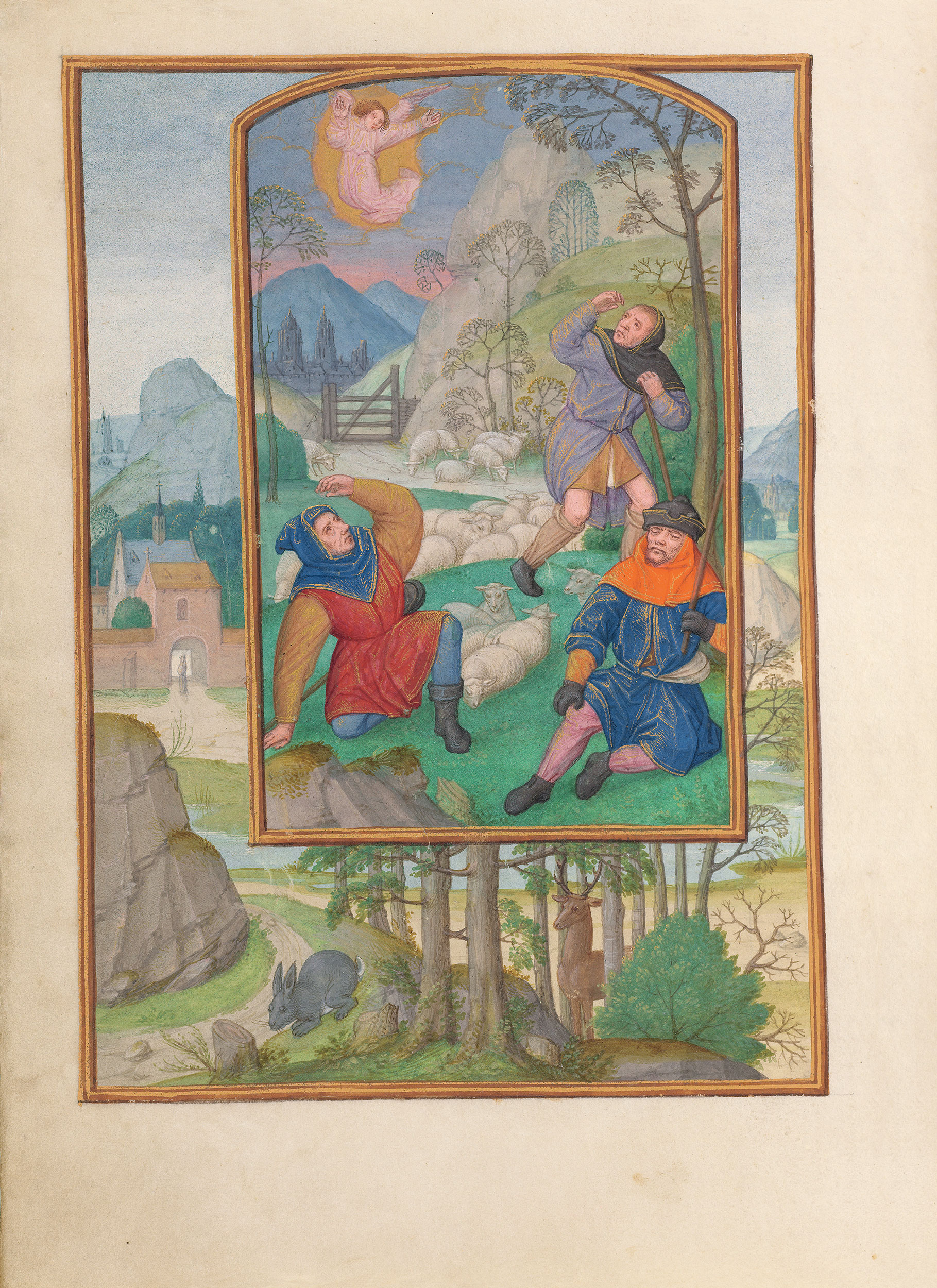
Simon Bening has chosen to depict the moment the single angel visits the shepherds as told by St Luke and St Matthew in the New Testament and has set the announcement to these humble men in a mountainous landscape in winter. We know this because there are no leaves on the the trees.
The outer margin shows a rabbit and a stag in the woods depicted in the bas de page, and the depiction of this outer landscape invites us to walk along the long winding road, past the woods with the stag and the rabbit, to the walled town seen in the middle distance where there is a person way ahead of us just entering the open gate. This marginal scene is shown in daylight, while the central image is of the single angel tappearing to the shepherds just as dawn is breaking over the distant mountains. The two different representations of time of day is Bening’s way of suggesting the distance the shepherds will have to travel to arrive at the stable where the Holy Family are resting.
The late 15th century Portinari altarpiece (now in the Uffizzi, Florence) by Hugo van der Goes depicts the shepherds just as they have arrived at the stable and are in the process of kneeling in adoration.

Simon Bening’s father, Alexander, had married into the van der Goes family, (probably Hugo’s sister, but we are not certain), and there are many similar pieces of content and symbolic elements in the works of van der Goes that appear in the many works by Alexander and Simon Bening. For example the tied sheaf of corn at the very bottom of this scene also appears in Bening’s Nativity scene in the da Costa Hours (f151v) which was the focus of my previous post. In this large altarpiece Van der Goes also features contemporary 16th century architecture, as seen in the margins of the announcement to the shepherds in the da Costa Hours, thus reminding us that time is irrelevant for the story of Christianity. The heavenly host, including all four archangels are present in the altarpiece, and the whole of humanity (represented by the shepherds and Joseph) are placed only just outside the sacred space. The sponsor and his family are separated from this scene and are depicated together with their patron saints, in the outer two wings that are hinged to close over the central scene.
To view the whole altarpiece you can either click on this link (Portinari Altarpiece), or perhaps visit the Uffizi in Florence in person. It is a glorious place to visit and I’d recommend going in winter when there are fewer tourists.

 Melanie V Taylor