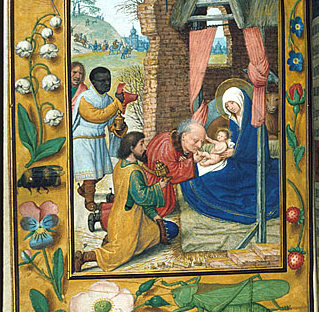
This post is a day late, but here are two beautiful full page miniatures by Simon Bening of his interpreation of the Adoration of the Kings on the Feast of the Epiphany.
The first is from the da Costa Hours (MS M 399) now in the Morgan Library, New York.

This beautiful book of hours is an exquisite example of Bening’s work, and dates from c1515.
The margin is separated by representationsn of pearls laid out in a diamond pattern. The jewelled borders have two examples of the goldsmith creation of tri-coloured pansies and the central green stones represent the hope the birth of the Christ Child brings to the world. Top left there is a similar jewellery version of a pansy, but is bi-coloured and has a red stone set at its centre. Red symbolises love and sacrifice, so this single pansy represents the Saviour’s love of the world and His ultimate sacrifce. The pansy is a reminder to the reader to think about the scene, and the colours remind them to consider mankind’s hope that the holy birth brings to the world.
The eight sided lozenge beneath this bi-coloured pansy contains a representation of St Veronica who is holding up her veil that is imprinted with the face of Christ. This reminds us of the legend of St Veronica who wiped Christ’s face as he laboured carrying the cross on the road to Calvary. So the legend goes that His sweat created a representation of His face on her veil.
Another eight sided lozenge immediately below the scene of the visiting kings is of the Agnus Dei, a reference to St John the Baptist utterance ” Behold the Lamb of God who takes away the sins of the world.” (St John Ch 1 v29). This emblem of Christ is seen in the central panel of Van Eyck’s Ghent altarpiece, created nearly century before this book of hours. The Agnus Dei stands on an altar and van Eyck has placed it immediately under the representation of God in the top central panel who is flanked by the Virgin on God’s right hand, and St John the Baptist on the left.
The second image of the Adoration of the King’s is from another Bening full page illumination.

This time the margins celebrate the natural world, but the symbolism referencing aspects of Christ’s life is similar. The rose is one of the Virgin’s symbols, and the fully flowering white rose represents both Mary and faith. The red rosebud in the smaller side margin is a reminder for us of the sacrifce this Infant will make when He is an adult. The five leaves remind the faithful of the five wounds. The inclusion of the forget-me-nots need no explanation.
The redcurrants appear in various illuminations that emanate from the Bening workshop (and others) and represent the drops of blood from the wounds of Christ. The strawberry is a symbol of the Resurrection and its leaves represent the Trinity. The lily of the valley are one of the earliest of the spring flowers and they too represent the Resurrection.
The bee appears to be an accurate portrayal of a buff tailed bumble bee and in the early 16th century bees were thought to be a patriarchy. It was not until the 17th century was it discovered that bees had a queen. I’ll leave that thought with you to ponder on.
The inclusion of grasshopper is more difficult to understand. It does not appear in the medieval bestiaries, nor in Jacob van Maelant’s 14th century manuscript Der Naturem Bloeme (Koninklijke Bibliotheek, KB, KA 16). The conclusion I came to was that it was a reference to Aesop’s fable of the grasshopper and the ant, and therefore a reminder that one should store up treasures in heaven as opposed to toiling for those on earth. Since grasshoppers are not long lived it could also be a reference to the short time Christ spent on earth.
The peacock feather reminds us that in ancient times of persecution this was a symbol of Christianity.
Those of the Orthodox faiths are celebrating Christmas as they follow the Julian religious calendar, while we in the West follow the Gregorian, hence the difference in the number of days Christ’s birth is celebrated by the different types of Christian faiths. For those who are members of the Greek and Russian Orthodox church, here’s wishing you a peaceful Christmas and New Year.

 Melanie V Taylor