
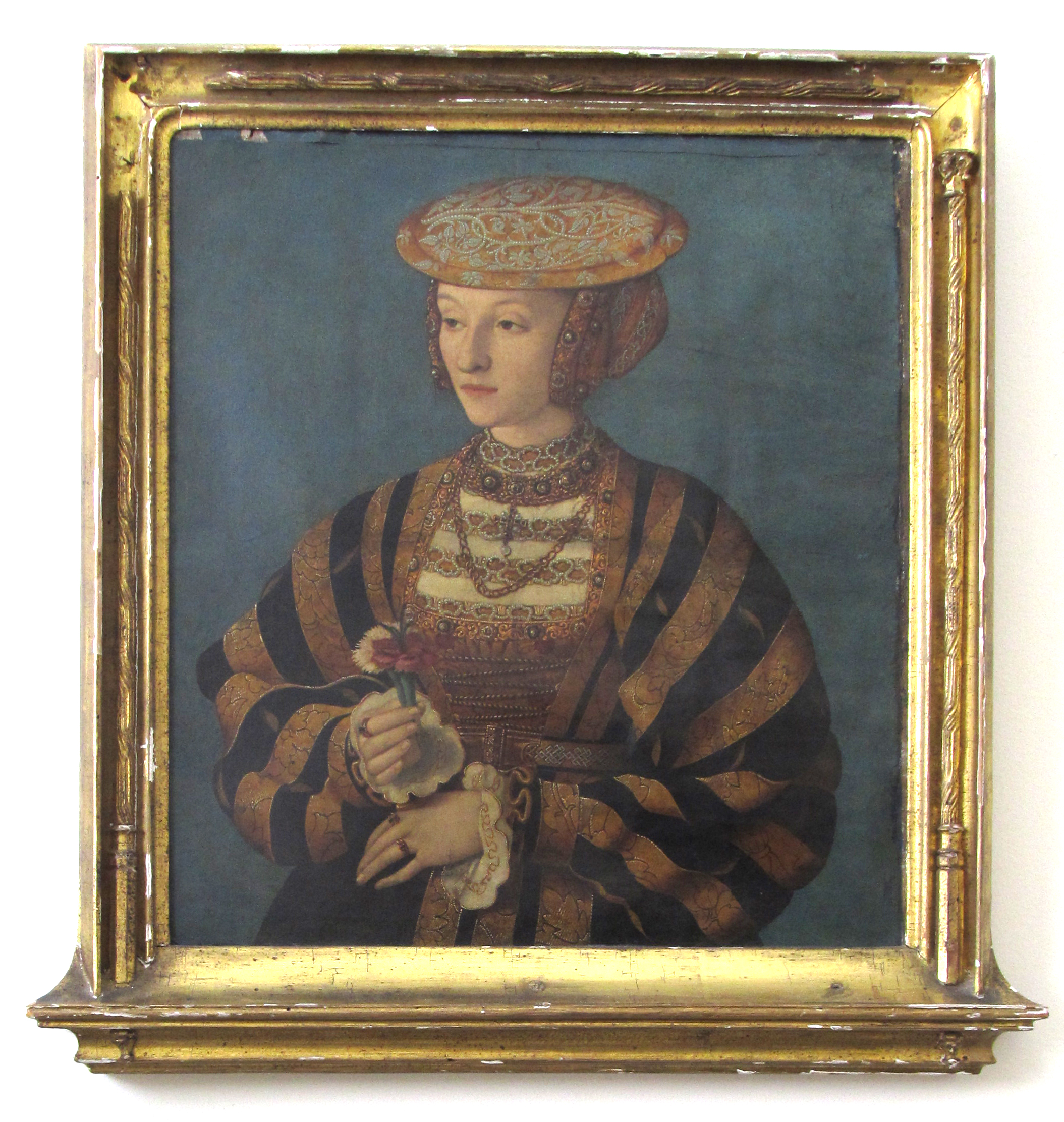
Anna, Duchess of Cleves (?) Hans Holbein the Younger (1497 – 1543) (?).
Rosenbach Museum, Philadelphia, USA. Accession Number 1954.1923.
When Heather Darsie’s consideration of Anna’s life and marriage was published in April 2019, the cover portrait (above) presented us with a completely different aspect of the duchess from the Holbein portrait that now hangs in the Louvre. Art history is all about provenance so I shall map out how the known Holbein portrait and the Rosenbach versions ended up in their respective museums. For ease of reference, I have provided links to other portraits (in bold) that will open in new windows when you click on them
At some point in the first part of the 17th century the Louvre portrait entered the collection of Thomas Howard, 14th Earl of Arundel (1585 – 1646). Arundel went into exile during the eleven years of Puritan rule in England from 1649 – 1660. Either he, or his executors, were forced to sell parts his art collection he had taken with him into exile in order pay off debts. The now famous portrait of Henry VIII’s fourth wife was acquired by the businessman and art collector, Everard Jabach (1618 – 1695) in the 1650s. In 1671 Holbein’s portrait of Anna was ceded to the collection of Louis XIV and finally entered the Louvre in 1793.
The portrait of the duchess on the cover of Ms Darsie’s book is painted on vellum and is held by the Rosenbach Museum in Philadelphia. It was sold on 11th July 1930 by Christie’s auction house to the Rosenbach brothers and the catalogue entry attributes the artist as being Hans Wertinger (1465/70 – 1533). Since Wertinger died in 1533 when Anna was eighteen years old, and a comparison of the Louvre and Rosenbach portraits suggests they were painted at about the same time, this puts Wertinger in his grave by six years when it is now agreed the Rosenbach was created. The Rosenbach had previously been sold by Christie’s in 1855 as part of the collection of the politician and art collector, Ralph Bernal (1783/4 – 1854) for 175 guineas.[i]
During the 19th century Victorian taste was focused on all things medieval. The Houses of Parliament had been destroyed by fire in 1834 and were rebuilt in the Tudor style to a design by Sir Charles Barry (1795 – 1860). The Beaufort portcullis, hallmark of Margaret Beaufort mother of Henry VII, continues to be the symbol depicted on the headed notepaper of the House of Lords, where it is printed in red, and in green on notepaper of the House of Commons. Just as today, the Tudors focused massively in the psyche of 19th century English people.
In 1890 the New Gallery at 121 Regent Street, London, hosted an Exhibition of the Royal House of Tudor and the exhibition catalogue contains descriptions of two panel portraits of Anne of Cleves. All the exhibits had been lent and unfortunately there are no images to accompany the descriptions. The artist of a panel measuring 15 x 11 inches, lent by a Henry Willett Esq., is unattributed, but another is attributed to Hans Holbein the Younger (1497 – 1543). The description that accompanies this panel (28 x 21 inches) is as follows:
“Half-length, life size, to left, black square-cut dress, edged with red, and trimmed with gold brain and lace, red slashed sleeves, black hood with white and jewelled pearl necklace, gold chain round neck, hands folded holding massive gold chain. This picture is stated to have been ‘for many years in the possession of the royal family of Sardinia, and is supposed to have been formerly in the collection of Charles I. Lent by Miss Morrison.”
Being described as ‘supposed to have been formerly in the collection of Charles I’ suggeststhat after the king’s execution it, like the Louvre portrait, had ended up abroad. Where these two panels are now is unknown. It is possible that more recent research has identified them as being portraits as being of someone else, or they are now in private collections.
The Winter Exhibition of 1899 – 1900 catalogue (also held at The New Gallery), included the portrait we now know as the Rosenbach. It is listed as Cat No 44 lent by a Dr Wickham Flower. After this exhibition the portrait does not emerge into the light again until the Christie’s auction of 1930 when it was sold by Sir John Frecheville Ramsden. How it came into Ramsden’s possession is another mystery.
Previously, in the 18th century a separate portrait on panel was acquired by Dr W Holmes, President of St John’s College, Oxford. It was not until 1855 that it was suggested that the sitter was Anna, Duchess of Cleves, 1855 being the same year the Bernal (now known as the Rosenbach) portrait was sold. Clearly someone had seen both portraits and concluded that they were of the same person, but not necessarily by the same artist. It had been Christie’s auction house that attributed the Bernal/Rosenbach portrait as being of the duchess and that the artist was Hans Holbein the Younger (1497 – 1543).
The Oxford portrait was included in various exhibitions in 1904 and 1911 described as Anne of Cleves. Mrs R L Poole included it in her 1925 Catalogue of Oxford Portraits[ii] and was the first to suggest there was an affinity between elements of certain portraits by Bartel de Bruyn, but Mrs Poole considered the style ‘archaic’. The de Bruyn atelier was based in Cologne therefore within easy reach of the ducal family seat, which is why the de Bryn atelier might have been asked to work for the dukes of Cleves.
Modern scientific techniques have provided art historians with non-invasive tools by which to distinguish fakes/copies from originals. In 1974 the Oxford portrait was subject to dendrochronological analysis. At that time it was concluded that the portrait was painted in the 17th century and was most likely a copy of a lost original.[iii]
In 1989 the panel was re-examined, this time by Candy Kuhl. The painting was minutely examined using X-ray, which revealed a “mutilated inscription ‘ANNA D.G. REGINA ANGLIAE FILIA IOHANNIS 3DU……”,[iv] and had been overpainted. It was concluded that it may possibly have been added later therefore the decision was taken not to reveal the inscription.
The X-ray examination also revealed that originally Anna’s nose had been altered, the pentimenti showing it as being slightly longer. The presence of this change to Anna’s profile on the gesso demonstrates the St John’s portrait is more likely to be an original as opposed to a copy of a ‘lost’ portrait.
The pigments and ground were also examined and found to be consistent with 16th century use and practice. The 1989 examination revealed that the original panel had been removed ‘fibre by fibre’ to the level of the original gesso and a fabric layer added before the whole was re-mounted on a new panel. The 1974 expert had concluded the cut and saw marks on the new panel date fo the St John’s portrait dated from around 1650 and were certainly not of the type seen in the 16th century, hence the conclusion then that the painting was a copy. The dating of the saw marks to 1650 equates with the outbreak of the English Civil War and the imposition of Cromwell’s Puritan Commonwealth on the English people.
The 1989 examination also revealed that the current frame may not be the original since when the painting was removed from the frame the original green background was revealed. No consideration seems to have been given that after being fitted on to a new panel in 1650, the painting was replaced in the original frame and then subsequently overpainted in order to hide the inscription, unless this conclusion came from dendro analysis of the frame that is not included in the 1992 article.
Scientific processes have improved since 1989 and by using non-invasive Raman spectroscopy it may now be possible to narrow down a date from analysis of the pigments used for the inscription. As to why the background and the words identifying Anna were overpainted may well have been a decision taken during the English Civil War in order to hide Anna’s identity from over-zealous members of Oliver Cromwell’s army determined to root out royalist sympathisers. Without the inscription any Puritan soldiers would have thought it was merely a painting of an unknown woman wearing a posh frock as opposed to being one of Henry VIII’s wives.
From the presence of the over-painted inscription identifying the sitter as Henry VIII’s fourth wife we can conclude that Anna was a popular person. Since she had not falllen from the king’s grace, and was regarded as his ‘beloved sister’, her portrait may have been reproduced for those wishing to demonstrate their loyalty to the king and his family by having her image on their walls. If the Oxford painting is of a later date then it demonstrates just how popular Anna remained in the minds of the public long after her death in the 1550s. By way of contrast to Anna’s popularity, the royal accounts show that every effort was made to remove visual references in royal palaces to Henry’s second wife and fifth wives, Anne Boleyn and Catharine Howard, after their downfalls.
It has been proposed that the Oxford portrait may be the one that was originally sent to England for the king’s scrutiny. Since the queen is in profile it may be why Henry VIII sent Holbein to paint an image the king knew he could trust as being accurate. Another version, similar to the Oxford version, is known by photograph alone and belonged to a dealer called Dowdeswell.[v] Until that one is found and subjected to forensic analysis it is pure speculation regarding which version might have been the one originally sent to England.
While all this is very interesting, it does not answer the question as to why is the Oxford portrait is important to the Rosenbach?
The dress worn by Anna in the St John’s portrait is the same, or very similar, as that seen in the Rosenbach and as Peter Hacker concluded, it was unlikely that the two sisters, Anna and Amalia, would have been painted wearing the same costume in portraits to be sent to the same potential bridegroom.[vi]
In the 1992 Burlington magazine article the authors describe the Rosenbach as “whereabouts unknown”,[vii] yet had gone so far as to discover that the painting had been purchased in 1930 by Alec Martin for £2,205. Mr Martin was apparently acting on behalf of a client, presumably the client being the Rosenbach brothers.[viii]
The 1930s Christie’s catalogue included further items from the same collection as the Rosenbach, all of which were under the group heading: “The following are the property of Sir John Ramsden, Bart., and have been removed from Bulstrode, Gerrards Cross, Bucks [Buckinghamshire]”.[ix] The phrase “removed from …” suggests the sale of Sir John Ramsden’s artefacts was not voluntary. Sir John Frecheville Ramsden came from an old English aristocratic family and had inherited a fortune from his parents including the family house and grounds known as Bulstrode Park. Unfortunately he had not inherited the business acumen of his father. Sir John had the nickname of ‘Chops’ and by all accounts was a mman of an extravagant nature and lover of all good things. By all accounts his life style was funded by selling the family property holdings in Huddersfield in 1920, which happened to be most of the town. Since the Rosenbach portrait was sold only a year after the Wall Street Crash of 1929, together with the catalogue wording “removed from …”, we can deduce Sir John had lost most or all of the family fortune at this time.[x]
In 1942 the attribution changed again. This time the German art historian Karl Feuchtmayer made the attribution as being by ‘the circle of Bartel de Bruyn the Elder (1493 – 1555)’. Feuchtmayer made this attribution in Thieme-Becker, Vol 36, published in Leipzig (p431). Considering this attribution was made at the height of World War II and the painting had been sold some twelve years previously, was Feuchtmayer working from photographs? There may be some political reason why Feuchtmayer downgraded the attribution to ‘the circle of’ as opposed to naming a specific ‘master’. One reason might have been because the German Holbein had lived the majority of his life in England and Feuchtmayer saw this as a betrayal by the 16th century German artist. Feuchtmayer was living in Nazi Germany and I admit this is speculation as I have not researched Feuchtmayer’s political alliances. As far as the Rosenbach portrait was concerned by 1942 the painting was safe in Philadelophia and the Rosenbach brothers believed it to be a genuine Holbein.
To demonstrate the popularity of de Bruyn and why attributions to the museum’s painting have seesawed between him and Holbein the Younger, it is known that de Bruyn was influenced by Holbein. The Mauritshuis have acquired a portrait of the lawyer and scholar Jacob Omphalius (1500 – 1567) painted in 1538 just a year earlier than the Holbein portraits of Anna, but possibly at the same time as the Oxford portrait. In a London auction of some 125 years ago the portrait pf Omphalius had been separated from the matching portrait of his fiancée, Elizabeth Bellinghaus (1520 – 1577) already owned by the Mauritshuis. This double portrait had been commissioned to celebrate their engagement and they married in 1539.[xi] Jacob Omphalius and Elizabeth Bellinghaus
Elizabeth wears her hair in braids and holds a sprig of bittersweet (Solanum dulcamara), a plant that produces berries that are poisonous to humans. The woman’s braided hair and the plant were local symbols of a forthcoming marriage. There has been a great deal of research into the ways different women of various nationalities wore their hair before and after marriage. St Paul’s first letter to Corinthians, Chapter 11 v2-15 lay out how married women should cover their hair and in a time where religion dominated everyday life, the adherence to Church rules in every day life for both men and women was required. In northern european altarpieces the Virgin Mary is the only woman in religious paintings portrayed with her hair flowing down her back as the symbol of her perpetual virginity, for example in Holbein’s 1526 altarpiece known aas The Darmstadt Madonna. This was created prior to Holbein leaving Basel.
In this altarpiece the donor, Basel Burgomeister Jacob Meyer zum Hasen, kneels on the right hand side of the Madonna with his two sons (they are not thought to have survived to adulthood). His two wives and daughter Anna, kneel on the other. His first wife had died in 1511, hence the white chin binding of one woman’s face signifying she was dead. The daughter, although not married, wears her hair braided over her ears like Elizabeth Benninghaus. It is thought that at the time the altarpiec was created she was engaged, and there are various other examples of paintings where young unmarried women who were not yet engaged are portrayed with the Virgin Mary who have their hair braided and covered in a similar fashion. This way of portraying engaged girls and married women suggests the portrayal of ordinary women within the same image in a religious image who were still virgo intacta, were not to be compared to the Holy Mother.
When it comes to individual portraits of a secular nature and in the case of those of Anna, Duchess of Cleves, her sister, Christina of Denmark and many others, used in marriage negotiations, then these images performed a different function – one of realistic portrayal, but still hold symbols that can be read with the wit to understand them.
In both the Rosenbach and the Oxford paintings Anna holds a bunch of dianthus, but her hair is hidden totally. Both women are portrayed as standing behind a stone parapet. Elizabeth Bellinghaus is about to be sheltered by the walls of marriage, but since the parapet does not extend right across her body gives us the clue that the marriage of these wealthy members of the merchant and legal elite is yet to happen.
The pair of gloves lying on the parapet in front of Anna in the Oxford painting tells us she is of noble birth, therefore this architectural feature carries a slightly different meaning. If these gloves were not enough of a clue to her rank of duchess, the parapet extends right across the painting separating Anna from the viewer completely. This is similar to what we see in other portraits of those of aristocratic but not of royal or imperial birth. Titian’s portraits of a man with a quilted sleeve and Portrait of a Lady (La Schiavona) both by Titian (c1488/89 – 1576) now hang in the National Gallery, London. Holbein’s contemporary has placed his sitters behind parapets, suggesting these individuals were of high rank within Venetian society.
The presence of the orange in the Oxford painting is yet to be explained, but oranges first appear on the window sill in the National Gallery’s 1434 Arnolfini portrait by Jan Van Eyck (1390s – 1441). What they symbolise can only be guessed at, but it may be that they, like the flowers in the de Bruyn portrait of Omphalius and Bellinghaus (Solanum dulcamara), represent the ‘bittersweet’ prospects of marriage.
Cleaning of the St John’s portrait has revealed the original delicate handling of both paint and subject. The colour of the parapet was revealed as being grey, and the ring on Anna’s little finger. A pyramidal jewel on the top of her headdress also came to light. There appears to be a similarity in style between the St John’s College portrait and other de Bruyn portraits, but much less so with the Rosenbach. Whether the Rosenbach comes from the de Bruyn atelier is difficult to say without actually examining it in person (me being in England and the Rosenbach on the other side of the Atlantic.)
The Rosenbach and Louvre portraits of the duchess are both painted in oil on vellum. Vellum being light and easily transportable makes it the perfect medium for an artist on an international mission to paint a prospective royal bride. Perhaps an alternative question should be did Bartel de Bruyn the Elder, and/or the de Bruyn workshop, ever paint portraits in oil on vellum? If not, then it appears we can rule de Bruyn and his atelier out of the equation as being the creators of the portrait in Philadelphia.
Comparing a high resolution of the Rosenbach portrait to the Louvre portrait, and widening the comparison to various miniatures, what strikes the eye is the similarity of the faces. The large three quarter profile facing left is softer than the Oxford portrait, but both are clearly of the same person. We can only speculate as to why Holbein may have painted the Rosenbach. Perhaps it was for his own collection? Or this is the first version emulating the pose of the Oxford version so they could be compared side by side? Perhaps Holbein then painted the Louvre version of Anna facing face on to be similar to his 1538 portrait of Christina of Denmark (National Gallery, London). Unlike the two images of Anna, Christina is painted on oak panel.
Subjecting the Rosenbach painting to the latest non-invasive scientific analysis and comparing the results with any similar analysis undertaken on the Louvre portrait would help throw a scientific light on authorship of the Philadelphis portrait. All scientific analysis needs the agreement of the owners for their priceless paintings to be subjected to X-ray, infra-red or other non-invasive technology, and this sort of analysis is not cheap.
In Franny Moyle’s book examining the life of Hans Holbein the Younger, Moyle has come to the conclusion that a Holbein miniature in the Royal Collection Trust (RCIN42293) is not that of Catharine Howard, but more likely to be of Anna, Duchess of Cleves. It was not until the mid-18th century that this miniature was described as being of Howard this attribution comes mainly from the identification of the jewel around the sitter’s neck being the same as that seen worn both by Jane Seymour and Katharine Parr in Holbein’s portrait of Jane (now in Vienna) and that of Parr by Master John in London’s National Portrait Gallery. This particular miniature is thought to have been restored to the royal family after the restoration of Charles II in 1660, but at that time no name was attributed to the sitter. The entry on the 17th century inventory is : “A small peice Inclineing of a woman after ye Dresse of Henry ye Eights wife by Peter Oliver.” There is another version in the Duke of Buccleuch’s collection that can be traced back to once belonging to the Earl of Arundel. This version appeared as an engraving (by Jacob Houbraken) in a 1734 book by Thomas Birth titled Heads of Illustrious Persons of Great Britain, where the first attribution is first made.[xii]
A royal bride adopting the fashion of the country where she ended up residing was not a new one. Earlier in the sixteenth century Henry VIII’s sister, Mary Tudor, was painted by Johannes Corvus prior to her marriage to Louis XII of France. Corvus depicts Mary wearing the gable headdress worn at the English court. On Mary’s return to England in 1516 she brought with her the less cumbersome French style headdress we see in this double portrait painted after Mary’s secret marriage in France to Henry VIII’s great friend, Charles Brandon, Duke of Suffolk before she returned to England. (Mary Tudor & Charles Brandon). It is therefore not without precedent for Anna to have adopted this style of headwear having settled in England.
By comparing the Holbein miniatures of Anna now in the V&A (below) and the one in the Royal Collection that may, or may not be of Anna it is possible to see that these two miniature portraits are of the same woman who is wearing different fashions from the known portraits. If you think there is going to be some computer wizardry, bear in mind that no matter how good computer technology, the best computer for making comparisons for facial recognition is the one we have between our own ears.

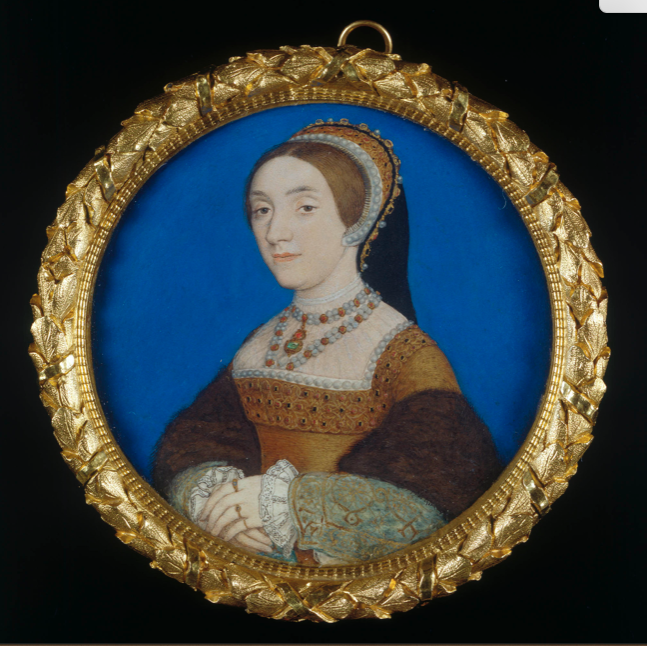
The eyes, with the slight cast in the sitter’s left eye is the same, and the lips are almost identical. Comparing the rings would be another way of identifying whether or not the jewellery was a personal possession or part of the royal collection (as in the emerald, ruby and pearl pendant). If the rings are personal, they may match those seen in the Oxford, Rosenbach and Louvre larger portraits.
In the V&A miniature, in addition to wearing German style clothes, Anna has a crucifix at her neck – a clear statement of her Catholic faith. Wearing a crucifix after her marriage to Henry VII would suggest she looked to the Pope as her spiritual guide rather than her husband who had so dramatically broken with Rome in order he might marry wife number two, Anne Boleyn and was the Supreme Head of the Anglican church.
The pendant in the Royal Collection miniature first appears in the portrait of Jane Seymour (now in Vienna) and later that of Katharine Parr It is comprised of three precious gems whose colours symbolise faith (the white pearl), hope (the green emerald) and charity (sometimes described as love) . St Paul’s first letter to Coronthians Ch 13 v1 – 13 establishes the significance of these three virtues, the greatest of which is charity – symbolised by the red ruby. This appearance on the portraits of Henry VIII’s third and sixth wife suggests the pendant was part of the royal collection and not part of Queen Jane’s personal jewellery.
For those who quibble about the hair colour being evidence that the Royal Collection Holbein miniature is not of Anna should take a closer look at the other portraits of the duchess. The German style headdresses cover the duchess’s hair completely making it impossible to make a convincing challenge to Moyle’s hypothesis.
It is documented that Henry VIII discarded Anna as his wife because she was ugly. However, anyone seeing these portraits realises this was not so.
Today we know there are at least three ad vivum portraits of Anna in existence, plus there are the two Holbein miniatures of the woman who became Henry VIII’s ‘beloved sister’, the second having a copy in the collection in Scotland. Unlike Henry’s second and fourth wives whose portraits, and any other visual references were destroyed immediately these women fell from grace, the existence of so many contemporary portraits of the Duchess of Cleves suggests that of all the king’s six wives, Anna remained popular even after the divorce. Technical analysis has proven that the inscription on the Oxford version by de Bryn may have been overpainted to protect that portrait from being destroyed during the English Civil War.
Whether the Rosenbach is by Holbein remains to be proved. I, for one, hope it is.
Mell Taylor
1st June 2021.
Footnotes
[i] A Portrait of Anne of Cleves: Peter Hacker and Candy Kuhl; The Burlington Magazine vol 134 No 1068 (March 1992) pp172 – 175: URL: https://www.jstor.org/stable/885027 Accessed 18th March 2019.
[ii] Ibid.
[iii] Ibid
[iv] Ibid.
[v] Ibid 175.
[vi] Ibid p173.
[vii] Ibid
[viii] Ibid, footnote 9.
[ix] Many thanks to the Rosenbach for providing me with the small amount of information they have on file for this painting.
[x] The 2017 book, ‘Poverty is Relative’ by Muriel Buxton , tells the story of Huddersfield and the town’s relationship with the Ramsden family. Apparently the title is something ‘Chops’ Ramsden’s bank manager said to him whenever Chops went to see him.
[xi] Codart.nl (accessed 14/05/2021)
[xii] While the sitter is not named, the artist is stated as Peter Oliver who was the son of Hilliard’s protégé Isaac Oliver (c1565 – 1617) born in 1584 and died in 1648. Later research has proved the artist to be Holbein the Younger.
Sources:
Buxton, Muriel; Poverty is Relative; Wordperry Press; 2017
Campbell, Lorne; Renaissance Portraits; Yale University Press; 1990.
https://www.codart.nl/art-works/mauritshuis-acquires-portrait-of-jakob-omphalius-by-batholomaus-bruyn/ Accessed 05/14/2021.
Darsie, Heather; Anna, Duchess of Cleves : The King’s Beloved Sister; Amberley, Stroud; 2019
Foister, Susan; Holbein in England; Tate Publishing; 2006.
Hacker, Peter & Candy Kuhl; A Portrait of Anne of Cleves: The Burlington Magazine Vol 134 No 1068 p172 – 175, via Jstor
Moyle, Franny: The King’s Painter : The Life and Times of Hans Holbein: Apollo 2021.
The Royal Collection Trust entry for RCIN 422293
Tudors to Windsors; ed Tarnya Cooper; National Portrait Gallery, London.
1890 exhibition catalogue: Exhibition of the Royal House of Tudor; R. Clay; The New Gallery, London; 1890 digitised version accessed via www.HathiTrust.org

 Melanie V Taylor
Beautiful paintings. Yes, I’m inclined to agree that the other miniature is Anna in a French hood: her features are v distinctive. But the Rosenbach portrait is an absolute stunner!
LikeLike