
Now the days are growing longer our thoughts turn to holidays and weekend breaks and Tiverton Castle should be on any history lover’s list of places to visit, and even stay. Whether it is visiting the castle as a day trip, or if you want a base from which to explore the West Country then staying in one of the castle’s holiday lets the castle is a place to visit.
The two counties of Devon and Cornwall project out into the Atlantic Ocean forming the toe of England. The weather (being England we have weather, not climate) is described as oceanic and the prevailing wind is from the south-west. The Industrial Revolution of the 18th and 19th centuries and the Napoleonic wars brought about a terminal decline in the centuries old wool trade, but Tiverton weathered that decline. From the bronze age, through the Norman conquest of William, Duke of Normandy in 1066, the reign of the Plantagenet kings, the Tudors and right through to the 20th century when the south coast of Devon saw the top secret rehearsals of the D-Day landings, there is every type of history for history lovers. If history is not your particular interest then there are the many walks through the attractive countryside as well as the beautiful beaches where everyone can explore and relax.

It is at Tiverton that the Rivers Exe and Lowman meet and archaeological evidence demonstrates there has been settlement here since the Stone Age. Iron Age hill fort known as Cranmore Castle is set on Exeter Hill above the town and has clear sight lines to other Iron Age settlements at Cadbury Castle, Huntsham Castle, Dolbury, Stoke Hill, Raddon Top, Posby and Cotley. Such clear sight lines between these areas suggests there must have been a signalling system to warn of the approach of enemy incursions. We know that when the Romans occupied the Iron Age settlement at Stoke HIll it became a Roman signalling post.
The West Country has a rich history of tin mining with the Phoenicians and Romans sailing all the way from the eastern Mediterranean to Cornwall and Devon to trade for the rich tin, copper, lead and silver ore deposits. It is thought the Phoenicians could have been coming to this part of England from as early as 2000BCE. In addition to minerals it is very likely they also took other goods back to the Mediterranean with them, such as slaves.
Tin is vital in the production of bronze and while there were large copper deposits on the island of Cyprus, there were few tin deposits elsewhere in the Mediterranean. Since the Phoenicians left no written records about their travels we have to look elsewhere for references to bronze production, and we find those in the Old Testament and 14th century letters found at Tell el-Armana in Egypt in 1887.[i], [ii]
Roman finds have been discovered at the National Trust’s 19th century Knightshayes Court situated just north of the town. Those of us Brits who were taught English history in the 1950s and 1960s will remember being told that the Romans never got as far as Devon or Cornwall. These archaeological finds prove the Romans were just as keen to get their hands on the tin, copper, silver and lead to be found in the mines of Devon and Cornwall.
The next major arrivals were the Anglo Saxons, and the town formed part of the estate of Alfred the Great. Under the king’s will he left land on the Isle of Wight, in West Sussex, Hampshire, Wiltshire, Dorset, Somerset, Devon (including Tiverton) and the whole of Cornwall to his younger son, Æthelweard, making Æthelweard a very rich man.
During the years following the Norman conquest in 1066, the town passed from the control of Gytha, Countess of Wessex (a powerful, ambitious and allegedly ruthless, woman). Gytha was the wife of the perfidious Godwin, Earl of Wessex and mother of Harold Godwinson and Edith of Wessex. Edith was married to King Edward the Confessor and the pair never had children. When Edward died on 5th January 1066 he was buried in Westminster Abbey the following morning and Edith’s brother Harold was crowned king with undue haste the afternoon of that day by Archbishop Stigand, except the then pope had refused to recognise Stigand since the previous archbishop, Robert of Jumièges, was still alive.
King Harold’s short, but bloody reign would come to an end on 14th October 1066at the Battle of Hastings when William, Duke of Normandy came to claim the throne that he believed was rightfully his. It was with this conquest that the history of England was changed forever.
With the expansion of Christianity the various religious orders established monasteries, abbeys and priories across England, and many cathedrals. English wool was of fine quality and the trade became a vital source of income for these communities. In order to get the fleeces to the continental markets it was much easier to transport these on the river. Tiverton is the Rivers Exe and Lowman meet and flow as the River Exe to the town of Topsham from where these valuable fleeces were exported to the european markets.
Tiverton Castle sits high above the river.
Today, stepping through the early 14th century gatehouse is to step back in time. The original cobbles are underfoot and the gable roof above your head. If you listen carefully you may hear the echoes of the clattering of horses hooves as they entered the stronghold all those centuries ago. It was King Henry I, fourth son of William the Conqueror, who, in 1106 gave permission for his loyal supporter Richard de Redvers (d1107) to build a defensive motte and bailey castle on this site. The motte and bailey construction had been used by Duke William when he was consolidating his position as a young duke and subduing various rebels lords in Normandy. Sitting right above the banks of the River Exe, the castle afforded clear views up and down the river since any trees blocking the sight lines would have been removed and used in the castle’s construction.
The Medieval Period
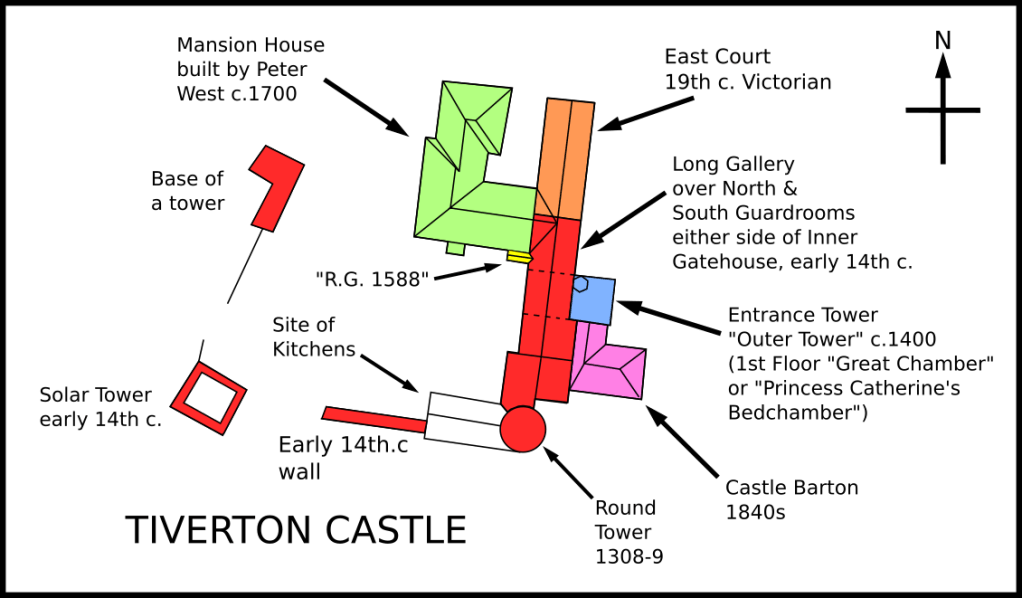
The earliest surviving part of the castle is the Round Tower and the various building coloured red on the detailed plan below. This plan shows the remaining elements of the development of the castle from the early 14ththrough to the 19th century.
The castle passed through the de Redvers family by descent until Isabella de Forz, who was the sister of Baldwin de Redvers, 7th Earl of Devon (1st creation).
Isabella is one of those powerful medieval women that few have ever heard of, but are important for the history of their period. Isabella’s brother Baldwin died in 1262 and had no children, which meant Isabella became the 8th Countess of Devon in her own right, plus she also inherited the feudal barony of Plympton and the lordship of the Isle of Wight making her one of the richest women in England. Needless to say all these riches made her a very attractive marriage prospect. The first to come in search of her hand was William de Forz, 4th Earl of Albemarle. William’s first wife, Christina (another heiress) had died in 1246 and at the age minimum age possible, in 1248/49 Isabella became the second wife of the 4th Earl of Albemarle.
William de Forz was influential during the reign of Henry III, making the young Isabella a force at court. Since William’s first wife had not provided the necessary heir (or spare) the very young Isabella’s job was to provide the necessary children to carry on the de Forz name. She and William had six children – four sons and two daughters. The first two sons died during their parents’ lifetime, the next two sons outlived their father, but predeceased their mother as did their sister, Avice. William died in 1560 leaving the now twenty three year old Isabella an extremely wealthy widow, with a young family including a one year old daughter, Aveline.
Four years later enter Simon de Montfort who desired Isabella’s hand in marriage. Simon was the second son of Simon de Montfort, 6th Earl of Leicester and since Isabella was tenant-in-chief of Carisbrooke Castle on the Isle of Wight and that meant a royal licence was required for her to remarry anyone. Not wishing to marry Isabella hid first in a priory in Hampshire and then in Wales.
The next to come seeking her hand was the king’s son, Edmund Crouchback, but he too was refused and instead married Isabella’s daughter, Aveline who died childless at the age of fifteen.
Isabella knew the law and was prepared to use it as the various surviving records of civil and criminal cases show. Besides these litigious records, she was also known for doing good works, which included providing a ‘leat’ for Tiverton. This artificial watercourse meant those living in the town had a constant supply of water that could also be used to fill a mill pond, which in turn would provide a head of water that drive a mill to grind grain, thus providing a source of flour for the townspeople. Further down the River Exe outside the city walls of Exeter Isabella financed the building of a weir. One source gives a date of 1284, but another from the last quarter of the fourteenth century states she had it built in 1272. The recorded descriptions are very different and show that the original weir had a thirty foot gap in the centre in order for boats to pass up and down the River Exe, allowing the transport of the all-important English wool to Topsham and thence to the rest of Europe.
One of the legends attached to Isabella is the settlement of a boundary dispute where four east Devon parishes met. She arranged for the disputees to meet near where the boundaries all met. The site was a bog and allegedly the countess took a ring from her finger and threw it into the middle of this marshy mess stating that where the ring lay was to be the boundary between the four parishes. Ever since then this place has been called “Ring in the Mire”.
On her deathbed in 1293 Isabella was ‘persuaded’ to sign over the Isle of Wight to King Edward I. The circumstances surrounding this transfer of land to Edward I has been viewed with deep suspicion by historians, but since we are unable to determine whether or not Isabella was sufficiently compos mentis to know what she was signing, historians will just have to accept it happened!
Tiverton Castle and the title then passed to Isabella’s second cousin once removed, Hugh de Courtenay, who became the 9th Earl of Devon (2nd creation) in 1335. De Courtenay was the great grandson of Robert de Courtenay and his second wife, Mary de Redvers (daughter of William de Redvers, 5th Earl of Devon (1st creation)), and the castle became the principal seat of the Courtenay family.
Through the Wars of the Roses the de Courtenay family generally supported the Lancastrian side, except for Thomas de Courtenay (either 5th or 13th Earl of Devon depending on which creation you prefer). Thomas had an ongoing feud with another local worthy, William Bonville. After the death of Thomas’s brother-in-law, John Beaufort, Duke of Somerset, the most powerful man at the royal court was William de la Pole, Duke of Suffolk, who favoured Bonville. Thomas de Courtenay’s feud with William Bonville, and Bonville’s elevation to baron in 1449, brought about a switch of Thomas’s allegiance to his friend, Richard, 3rd Duke of York. Over the ensuing years, Thomas’s feud with Bonville would have a lasting effect on the whole of the West Country, culminating in the Battle of Clyst Heath in December 1455. Bonville was defeated by the opposition and fled and a number of Courtenay’s followers looted Bonville’s home, Shute Manor. The people of Exeter were instructed not to help Courtenay or any of his army and eventually Courtenay submitted to his former friend, Richard, Duke of York, at Shaftesbury and was sent to The Tower. At this point, Henry VI has one of his rare bouts of sanity and removed the Duke of York as royal protector. The queen, Margaret of Anjou, took personal control of her husband’s court in place of the Duke of York and Thomas was restored to his lands and title.
Thomas died in 1458 leaving his widow, Margaret Beaufort (not to be confused with Margaret Beaufort mother of Henry VII), the daughter of John Beaufort, 1st Duke of Somerset and Lady Margaret Holland to whom he had been married in about 1420/21. Margaret’s father was the eldest illegitimate child of John of Gaunt (fourth son of Edward III) and his mistress Katherine Swynford. Thomas and Margaret had nine children of whom three sons and three daughters reached adulthood. The eldest, called Thomas after his father, was beheaded after the Battle of Towton in 1461 and his title of 6th/14th Earl of Devon was forfeit. The second son, Henry, was also executed for treason in either 1467 or 1469 depending on which record you read. Third in line was John, who had been restored as the 7th/15th Earl of Devon in 1470 while in exile with Margaret of Anjou. John died at the Battle of Tewksbury in 1471.
Tiverton Under the Tudors
With no male heirs to carry on the title, it became extinct until it was revived by Henry Tudor immediately after the Battle of Bosworth in August 1485 when the victorious King Henry VII created Edward Courtenay, 1st Earl of Devon in 1485 for his loyalty .
This side of the family were descended from Sir Hugh I Courtenay of Haccombe, who was the second son of Edward Courtenay of Godlington. This line of the Courtenay family had remained loyal Lancastrian supporters and Edward is believed to have had been secretly involved with Henry Tudor’s mother, Margaret Beaufort, and the dowager queen, Elizabeth Woodville, during the reign of Richard III, acting as courier between England and the exiled Henry Tudor, and returned with Henry’s forces and fought at the Battle of Bosworth in August 1485..
Ten years earlier in 1475, Edward had married, Elizabeth Courtenay, his third cousin once removed, and in the same year they had a son, William. Much in royal favour, at the age of twenty in 1485 William married the sixteen year old Princess Katharine, the sixth daughter of Edward IV and Elizabeth Woodville. Her sister Elizabeth was married to King Henry VII making Princess Katharine aunt to all the offspring of the nascent Tudor dynasty. Two years later William was with the royal forces at the siege of Exeter where the rebel forces of Perkin Warbeck were defeated. For William’s loyalty and service in helping defeat Warbeck’s forces, in 1498 the king granted him some lead and silver mines in north Devon.[iii]
Unfortunately, six years later William was arrested and flung in the Tower accused of being involved in the conspiracy to oust Henry VII from the English throne and replace him with Edmund de la Pole, 3rd Duke of Suffolk. Princess Katharine remained at liberty in the service of her sister, Queen Elizabeth, and their four children were placed in the care of Lady Margaret Coton. Because of William being attainted the lands and estate were now forfeit to the Crown, making Princess Katharine penniless. It was her sister, Elizabeth, now Queen of England, who paid for the children’s education and upbringing and for William’s requirements in The Tower. Edward, the younger of William and Katharine’s two sons died in 1502. Princess Katharine being without funds, meant the costs for the young Edward’s funeral were covered by his aunt.
William remained incarcerated until 1509 when he was released by the young Henry VIII. United once again, the couple returned to court. William’s father, Edward, 1st Earl of Devon, died in 1509 and in order for William to receive his inheritance (which included Tiverton Castle), it required the repeal of the Act of Deprivation of his right to inherit the lands and title of his father. This required the approval of the young Henry VIII who imposed certain restrictions including Katharine’s relinquishing her claim to the title Earl of March. All this legal action took until 1511, by which time William was seriously ill. The title was returned in the May together with the repeal of the Act that prohibited the succession of titles to the children. Katharine had several estates transferred to her personally, but not all the lands forfeited by Thomas de Courtenay were returned to William.
William died a month, leaving Princess Katharine to tie up the various legal loose ends before their surviving son, Henry, could inherit the title and lands. This required his mother to petition Parliament on his behalf. Through the mediation of the Bishop of London these ‘loose ends’ were finally tied off in October 1512 and the following month Parliament approved the transfer of both title and remaining lands to the ten year old Henry de Courtenay. After the death of William, Princess Katharine had taken a vow of celibac the previous year in order to bring up her two surviving children, Henry and Margaret, and now having got as much of her husband’s lands and estates restored as she could, she retired to her Devon estates spending her time between Tiverton and Colcombe castles.
Princess Katharine was, by all accounts, a very kind and benevolent person who did not pursue the ordinary folk who might have taken the odd rabbit from the estate (a deed punishable by death). She died in November 1527 at the age of nearly fifty at Tiverton Castle and is buried next door in the church dedicated to St Peter.
The young Henry de Courtenay, now Earl of Devon, was first cousin to Henry VIII and was closely involved at court,. In 1538 just like his father, de Courtenay was accused of plotting to put a de la Pole on the English throne. Whether or not this was true or because a certain Thomas Cromwell saw the young Henry’s influence becoming too much over his cousin the king, is a matter of debate, but the accusation led to de Courtenay’s execution on Tower Hill on 9th December 1538.[iv] As a result the rich lands and estates of the de Courtenay family were once again forfeit to the Crown.
On her succession in 1554 Mary I restored these lands and titles to Edward de Courtenay, the son of the executed Henry de Courtenay, but he died without issue and the Tiverton castle and lands were then divided into shares between the descendants of the earlier Edward de Courtenay, Earl of Devon who had died in 1509. Over time these shares were sold and eventually in the late eighteenth century the Carew family owned the majority share of the Tiverton estate.
Tiverton Castle in the 17th century
England’s Civil War broke out in 1642 resulting in nine years of Puritan rule.[v] Both the town and Tiverton Castle were Royalist and in October 1645 Oliver Cromwell’s army, headed by Major General Massey, took the town leaving the castle as the last bastion of the royalists.
On Friday 17th October Sir Thomas Fairfax set down outside the castle walls and demanded those inside surrender. The answer was a resounding NO! Having received this rebuttal from the governor of the castle, Sir Gilbert Talbot, Fairfax then set up his forces on Cranmore Hill approximately half a mile from the castle, and prepared to bombard the castle and all those in it. Fairfax had various forms of heavy artillery including the culverin, a new form of cannon capable of firing a cannonball a distance of 2,000 yards. Inside the castle were the governor, a Major Sadler, a further twenty officers, plus two hundred ordinary soldiers.
It was thanks to a lucky shot by one of Fairfax’s men that broke the chain of the castle drawbridge and the Parliamentary forces swarmed into the castle capturing those inside. The Parliamentarians had only suffered four casualties in the taking of the castle and Fairfax called for calm and ordered that those inside who were still alive should be spared. When it came to plunder that was a different matter, and the various pieces of royalist ordnance, munitions, provisions and the castle’s treasure was divided among Fairfax’s soldiers.[vi] Having divided the spoils Fairfax then ordered much of the castle’s defences to be demolished.
The Castle from the 18th century to the present day
From the plan we see that the West family rebuilt a wing in 1700, and in 1728 the castle passed to the Carew family, who added Castle Barton and the East Wing during the 19th century.
The Industrial Revolution brought about economic decline of the town. It was thanks to John Heathcote brought his lace making business down from the Midlands that this economic decline was reversed. Heathcote’s factory at Loughborough had been destroyed by Luddites employed by the lace manufacturers who had set up factories in Nottingham and did not want competition from nearby Loughborough. Heathcote came down to Devon, no doubt drawn by the tradition of hand-made lace made at nearby Honiton. He bought an old woollen mill left over from the medieval wool trade and set up his machinery, thus providing employment for many in the town. Today the factory is still there.
The Carew’s sold the castle in 1923 and it passed through various hands until the current owners took it on in 1985.
The wealth of history wrapped within the walls of Tiverton Castle embraces the casual visitor the minute you step through the castle gates. Today the gardens and romantic ruins form the perfect background for photo shoots. It was June when we visited and the day was overcast and humid which held the heady scent of the climbing roses in the air.
If you want just to visit the castle and its grounds, it is open on from Easter Sunday to the end of October on Thursdays, Sundays and Bank Holidays from 2.30 to 5.30 pm. Entry is cash only and £10/adult and £5 per child between the ages of 7 and 16, under 5s go free (no dogs). It is ideal for group visits (for 12 or more people). If you are a teacher it is a splendid place to bring medieval, Tudor and civil war history alive, so a school visit is a must. Groups of a maximum of 30 children and the preferred days are Tuesdays and Wednesdays.
If you are planning a more extended trip to the West Country, then one of the 3 holiday lets at Tiverton Castle would make the perfect place to make your base. To see the details of Pear Tree Cottage, Upper South Court and Lower East Court and to make a booking, follow this link https://www.tivertoncastle.com/apartments/index.php
Other Helpful information
Situated in the north east of Devon the town of Tiverton has easy access to the M5 motorway and the A361 North Devon Link Road. The town has had a rail link since 1844 and in 1986 the Tiverton Parkway railway station was opened six mile east of the town next to Junction 27 of the M5. There is an hourly bus service to Exeter Monday to Saturday. On Sundays and Bank Holidays the service runs every two hours.
Local attractions within walking distance of Tiverton Castle
https://www.tivertonmuseum.org.uk
St Peter’s Church. This current church dates from 1073, but has probably been a place of worship for very much longer as it is at the conjunction of five ley lines (f you are into that sort of thing).
Other Places to visit
Powderham Castle – The Courtenay family have been at Powderham for 900 years, and the modern castle you see today is a mere six centuries old. If you have watched the Antony Hopkins film, ‘Remains of the Day’ you will recognise the setting as Powderham.
Hartland Abbey Originally dating from the 12th century, at the Dissolution of the Monasteries Henry VIII gave the property to his Keeper of the Royal Wine Cellar, and it remains in the family to this day. Like Powderham, Hartland Abbey has been used by film makers, but with a longer history as a film set dating from 1934. The most recent film to have been filmed at the abbey is Enid Blyton’s ‘Malory Towers’.
Fursdon House. Still lived in by the family after 765 years, Fursdon House traverses the centuries providing the visitor with stunning views of the parkland all the way to Dartmoor, yet the house is very near to Exeter, Tiverton and Crediton. Between Easter Monday and the end of September is open to visitors on Bank holidays and on Wednesday and Thursday afternoons in June, July and August between 2.30 and 5.30 p.m. The guided tour takes you through the centuries from 1295 when the family first arrived.
Swanaford_Vineyard_Tour_And_Tasting_Experience. Over 18s. lasts 1.5 hrs £15/head. Max 20 per group.
Half day sea kayak. Ages 8 – 75, max 8 per group. £48/per adult. Teignmouth.
More recent Devonian history
For those interested in the preparations for the invasion of Normandy, code name Operation Overlord, the rehearsals for the D-Day Landings took place on the south coast of Devon. In particular Slapton Sands is notorious for having been attacked by German E-boats resulting in the loss of 749 American lives. The American author, J D Salinger, later wrote a short story about an American soldier suffering from PTSD after the Slapton Sands disaster while Salinger was staying in Tiverton.
National Trust properties
Knightshayes Court. 19th Century Gothic revival house designed by William Burges who also built Cardiff Castle; Castle Coch in South Wales; The Tower House, Holland Park, London. Knightshayes was built for the grandson of John Heathcote who brought his lace making factory to Tiverton in 1816.
Killerton. 18th century house and gardens with its roots in the 16th century.
Saltram. Georgian house and gardens near Plymouth
Buckland Abbey. Once a Cistercian abbey, after the Dissolution of the Monasteries the abbey belonged first to the Sir Roger Grenville who bought it in 1541. Sir Roger died aboard the Mary Rose (sunk in 1545) and it was his grandson who converted the property into a family home. It subsequently belonged to Sir Francis Drake, hero the Spanish Armada, the first Englishman to circumnavigate the world. Landing at Plymouth in September 1578 his first question is reputed to have been: “Is Elizabeth still queen of England.” He had returned laden with plunder from a Spanish galleon taken off the west coast of Panama colloquially called the Caca Fuego (that translates as The Fire Shitter). The queen had invested heavily in Drake’s voyage and today, the value of her share is still guesswork as she made it an offense ‘in perpetuity’ for the amount she made ever to become known known!
Castle Drogo. Designed in 20th century by Sir Edwin Luytens, the castle sits high up on Dartmoor.
Greenways Dartmouth. This is a Georgian house built on the site of a Tudor mansion constructed for the Grenville family who established colonies in Maine and Newfoundland. It is also where Agatha Christie lived in the 20thcentury. During the preparations for the D-Day landings in 1944, the house was requisitioned by the US coastguards and there is a frieze in the library painted during their occupation of the property.
These are just a few of the treasures Devon has to offer the visitor. So you see, the Devon is rich in history going back to the Bronze Age, ensuring there is something to capture the imagination of everyone.
This article appeared on http://www.TudorsDynasty.com in October 2024 & has Rebecca Larson’s photos of the castle and its beautiful gardens.
Endnotes
[i] The books of Exodus, Numbers, Joshua, Judges, 1st book of Samuel, 1st book of Kings. We also find references to copper in 14th century BCE cuneiform letters between the ruler of the eastern Mediterranean kingdom of Alashiya to Pharaoh Akhenaten
[ii] Knott, Elizabeth. “The Amarna Letters.” In Heilbrunn Timeline of Art History. New York: The Metropolitan Museum of Art, 2000–. http://www.metmuseum.org/toah/hd/amlet/hd_amlet.htm (October 2016)
[iii] Patent Rolls of 1498 discovered by Lt Col J Ramsden in 1946. My grateful thanks to Angus Gordon for sharing his encyclopaedic knowledge of the geological history of the area.
[iv] To listen to an in-depth interview with the Charles Courtenay, the current Earl of Devon, click the link https://youtu.be/wKJnbzUoDrM?si=CR7Ru06fWeN_Upq3
[v] There are many books on the English civil war. See above for Further Reading.
[vi] https://name.umdl.umich.edu/A92124.0001.001
Sources & Further Reading
https://www.metmuseum.org/toah/hd/amlet/hd_amlet.htm
http://www.gatehouse-gazetteer.info/English%20sites/894.html
Fraser, Antonia; Cromwell: Our Chief of Men; Weidenfeld & Nicholson; 2011
Hill, Christopher; God’s Englishman: Oliver Cromwell & the English Revolution; Penguin; 2019.
Hopper, Andrew; Black Tom: Sir Thomas Fairfax and the English Revolution; Manchester University Press. 2007
Hutton, Ronald; The Making of Oliver Cromwell; Yale University Press; 2022
(Forthcoming August 2024) Oliver Cromwell: Commander in Chief.
Jones, Dan; The Plantagenets: The Kings who made England; William Collins; 2013.
Keay, Anna; The Restless Republic; William Collins; 2023 (Short listed for the Baillie Gifford Prize for Non-Fiction 2023)
MacCulloch, Diarmaid; Thomas Cromwell. A Life; Penguin Books; 2019
Morris, Marc; The Norman Conquest; Windmill Books; 2013
A Great & Terrible King: King Edward I & the Forging of Britain; Windmill Books; 2009
King John: Treachery, Tyranny & the Road to Magna Carta. Windmill Books; 2016
Starkey, David; Henry: Virtuous Prince; Harper Perennial; 2009
The Monarchy of England; Harper Collins; 2005 (audio book)
Crown & Country; Harper Collins; 2009
Wilkinson; Josephine; Richard III: The Young King To Be; Amberley; 2008
The Princes in the Tower; Amberley; 2013

 Melanie V Taylor